AuraAura colors9 min read
Aura photography: how aura photos work and what they show
Aura photography explained: what aura camera sensors measure, why Kirlian glows come from moisture, how to read an aura photo and how AI portraits differ.
Aura photography is portrait photography with a colored glow added around the sitter. In a typical aura camera, you rest your hands on sensors that read signals such as skin temperature and electrical conductance, and software turns those readings into colors. The camera responds to your body, but what each color means is tradition, not science.
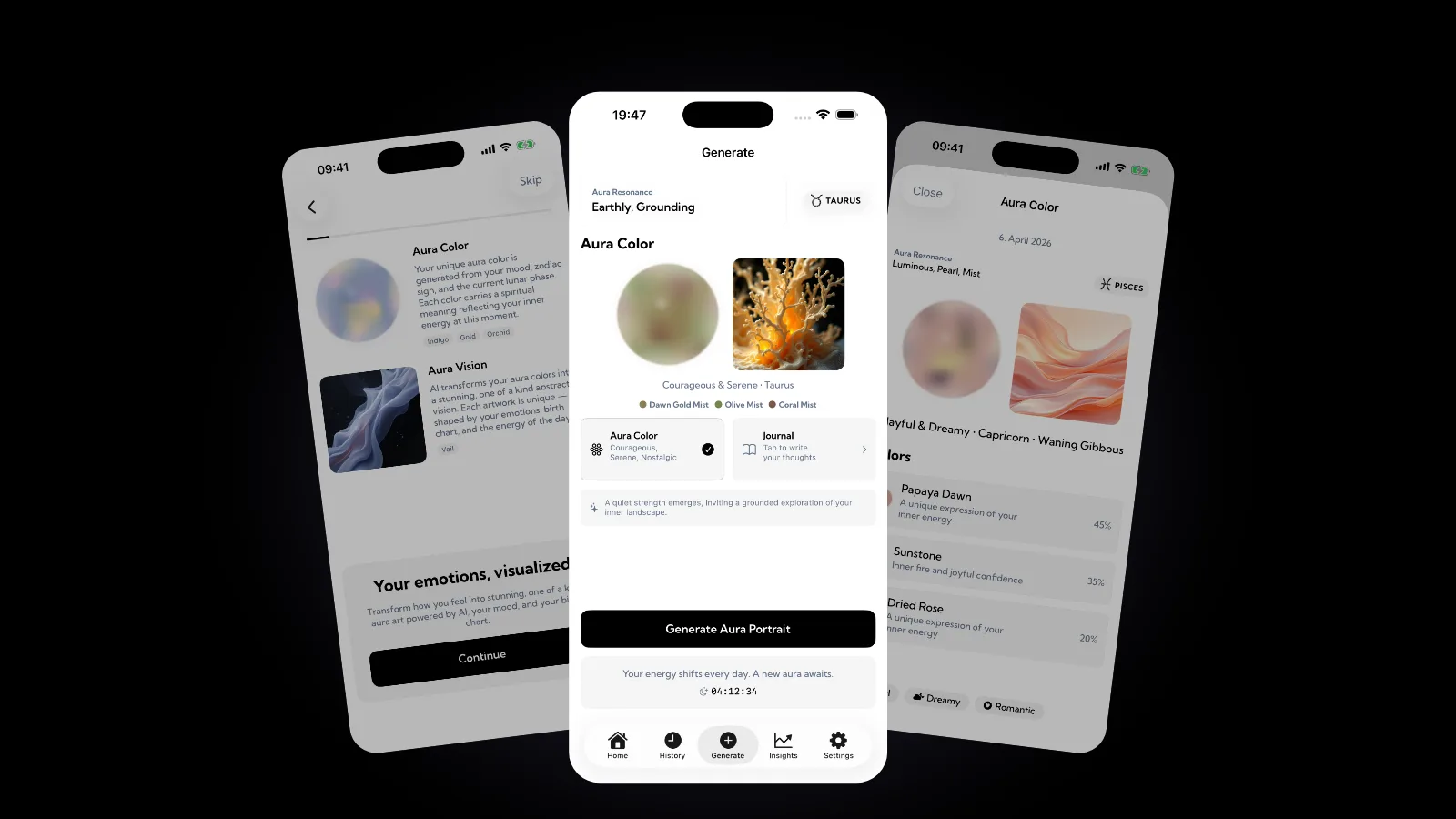
This guide explains what those sensors measure, where the older Kirlian glow comes from, how people read an aura photo, and how a camera compares with an AI aura portrait. We make Aura, an iPhone app that turns your mood into a daily aura color and AI art, so we cover the app route too.
What is aura photography?
Aura photography is a kind of portrait that shows a band of color around a person's head and shoulders, presented as their aura. Three very different things share the name. The first is the biofeedback aura camera found at pop-up booths: you hold your hands on two sensors while a camera takes your picture, and software paints a color field over the image based on the readings. The second is Kirlian photography, a technique from 1939 that records a real electrical glow around an object placed on film. The third, and newest, is the AI aura portrait, where an app generates artwork from a photo or from details you give it. None of the three has been shown to capture an aura. The encyclopedia entry on the aura in parapsychology notes that controlled tests of aura claims have repeatedly failed and that "instrumental searches have also been unsuccessful." What these methods do produce is a colorful, personal image.
How does an aura camera work?
An aura camera pairs an ordinary portrait camera with hand sensors. In 2012, NPR's Picture Show described one such camera in A Camera That Sees Your True Colors?: the sitter puts their hands on sensors that read biofeedback, such as temperature and electrical signals, and the camera translates that data as color.
NPR credits the original design to Guy Coggins and calls the result "basically like the mood ring of photography." Accounts disagree on when he built the first one. The maker's own description, quoted by NPR, says the readings are "projected as a radiant, colorful aura field around the body onto the Polaroid film." So the glow is added to the picture; it isn't light coming off your skin.
Modern booths work the same way. In March 2026, Axios Charlotte described a pop-up aura camera: visitors rest their hands on two biofeedback sensors and an instant photo comes out about thirty seconds later. The article says the camera reads skin conductivity and temperature, and software turns that data into the glow on the portrait.
A session usually runs like this:
- You sit in front of the camera and rest your palms on two metal hand plates.
- The plates read signals from your skin, mainly electrical conductance and temperature.
- Software converts the readings into a set of colors and decides where they sit around you.
- The camera produces your photo with that color field laid over it. Some systems also print a description of what each color is said to mean.
Are aura photos real?
The photo is real, and the sensors measure something physical. The meaning attached to the colors is not supported by science.
Skin conductance is a well-studied signal in psychology. A 2002 review in The Neuroscientist, Electrodermal responses: what happens in the brain by Hugo Critchley, calls electrodermal activity "a sensitive psychophysiological index of changes in autonomic sympathetic arousal." Put simply, the reading shifts when you're calm, nervous or excited. So an aura camera is reacting to your body, not inventing numbers.
The jump from reading to meaning is where the science stops. Someone decided which reading becomes orange, and that orange means you're creative and artistic, one of the meanings NPR listed. NPR also put it plainly: it's "not totally clear" how the conclusions about each color were drawn. The mapping is a design choice made by whoever wrote the software, so two systems could show the same reading in different colors.
An aura photo isn't a health measurement either. A booth camera isn't a medical device, and a color isn't a diagnosis.
Aura camera vs Kirlian photo vs AI aura portrait
Kirlian photography is older and works differently. According to the Kirlian photography entry, Semyon Kirlian found in 1939 that an object on a photographic plate, connected to a high-voltage source, leaves a glowing outline on the film. He and his wife Valentina developed the technique together. That glow is real: it's a corona discharge, a ring of tiny electrical sparks around the object's edges.
Some saw a life force in it. In 1976, J. O. Pehek, H. J. Kyler and D. L. Faust published Image modulation in corona discharge photography in Science. They found that "the presence of moisture on or within the subject's surface" accounts for most of the variation in the images. A sweaty fingertip and a dry one make different pictures.
Here's how the three methods compare:
| Aura camera | Kirlian photo | AI aura portrait | |
|---|---|---|---|
| What it records | A normal photo of you, plus hand sensor readings | An electrical discharge around an object on film | Nothing: it generates a new image |
| Where the color comes from | Software maps skin conductance and temperature to colors | Voltage, circuit settings and surface moisture | The model and the inputs you give it, such as a photo, mood or birth details |
| Is the glow physically there? | No, it's an overlay | Yes, but it's a spark, not an aura | No, it's artwork |
| Changes between sessions? | Yes, as your readings shift | Yes, mostly with moisture | Yes, every image is new |
| Best way to treat it | A fun mood snapshot | A physics demonstration | Personal art |
How do you read an aura photo?
Most readers start above the head. The color there is usually read as your current state of mind, the mood you were in when the shutter clicked. After that, conventions split. Which side is which? It depends on who you ask, so it helps to know the main ones before anyone interprets your picture:
- Above the head: usually read as your state of mind right now.
- The sides: one common convention reads one side as what you show the world or are moving toward, and the other as what you keep inside. Another reads the same two sides as your recent past and your near future.
- Left or right: readers don't even agree which side is "left". Some mean the left of the photo, others mean your own left, which appears on the right of a portrait.
- Strength of color: bright, clear colors are read as strong energy, and muddy or faint ones as tiredness or mixed feelings.
- Several colors: a photo with two or three colors is read as a blend rather than one fixed trait.
Ask which convention a reader follows before taking any reading to heart. Then look up the colors: our guide to aura colors meaning covers the main palette, and aura color combinations explains how two or three shades are read together.
Booth, camera or app: how should you get an aura photo?
Pick the option that matches what you want. A booth runs a real biofeedback aura camera and gives you a print to take home, plus a fun outing. An app gives you art you can make again tomorrow, without anyone reading your skin.
Before you book a booth or download an app, run through this short checklist:
- Ask what it measures. A clear answer, such as skin conductance and temperature, is a good sign. Vague talk about seeing your soul isn't.
- Ask how colors are read. Find out which side convention they use and whether you get a written explanation.
- Expect change. A different photo next week is normal, because your readings change.
- Check how it's sold. Art and entertainment are fair claims. Readings of your health are not.
- For an app, read what drives the color. A good app tells you what goes into it and doesn't pretend to scan your body.
Aura photos and aura colors are a prompt for reflection, not medical or psychological advice.
How does Aura turn a photo into an aura portrait?
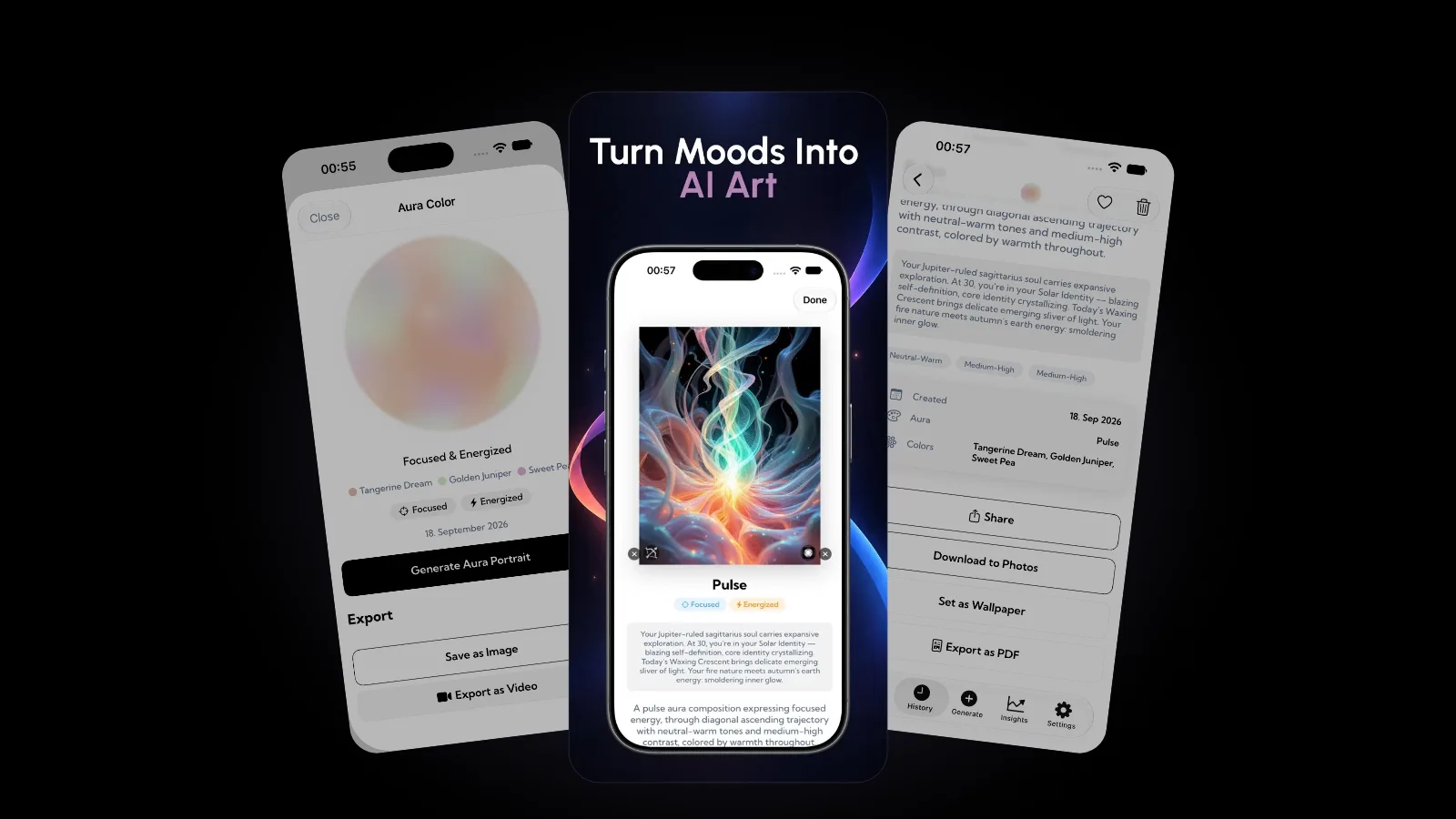
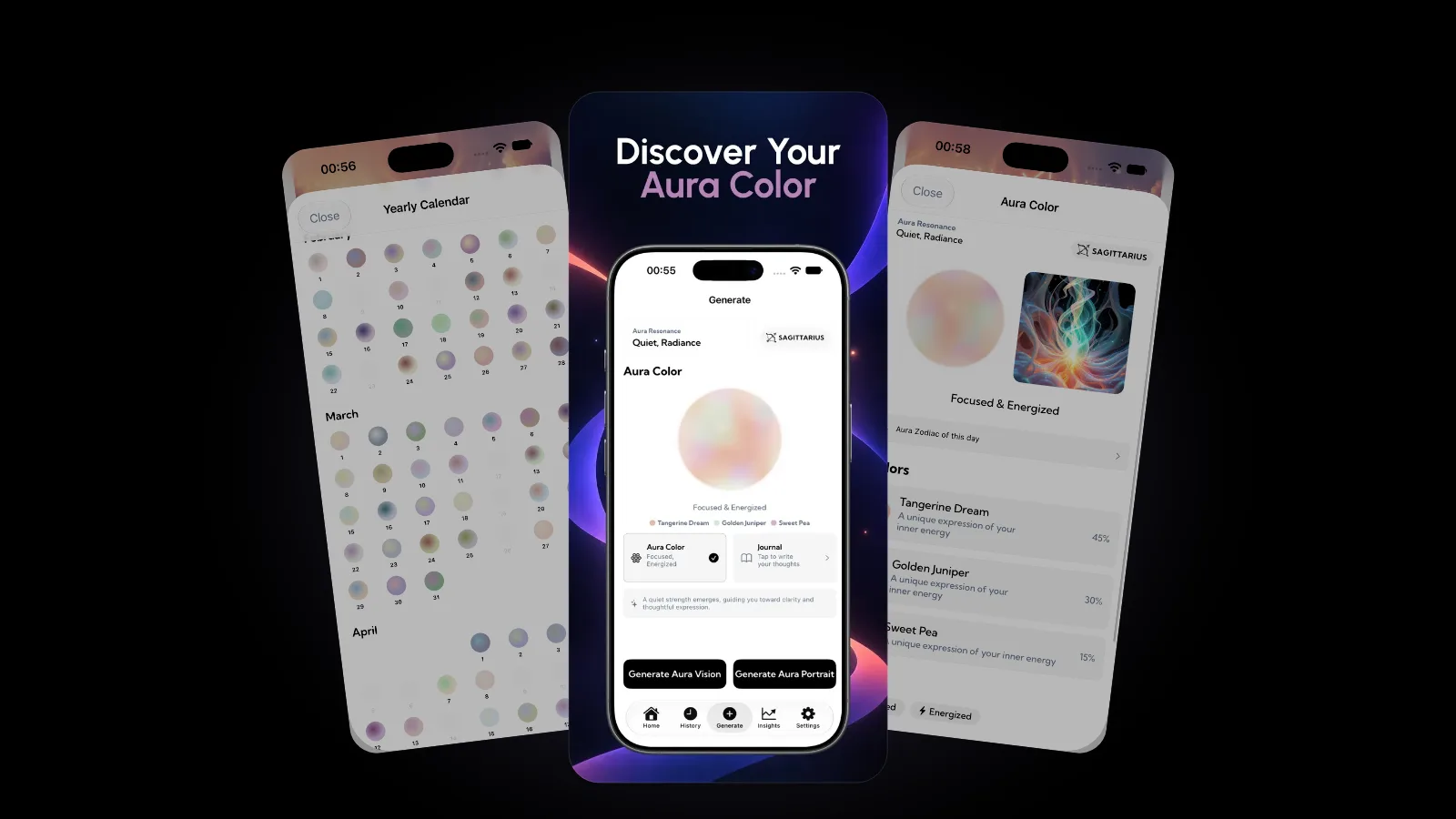
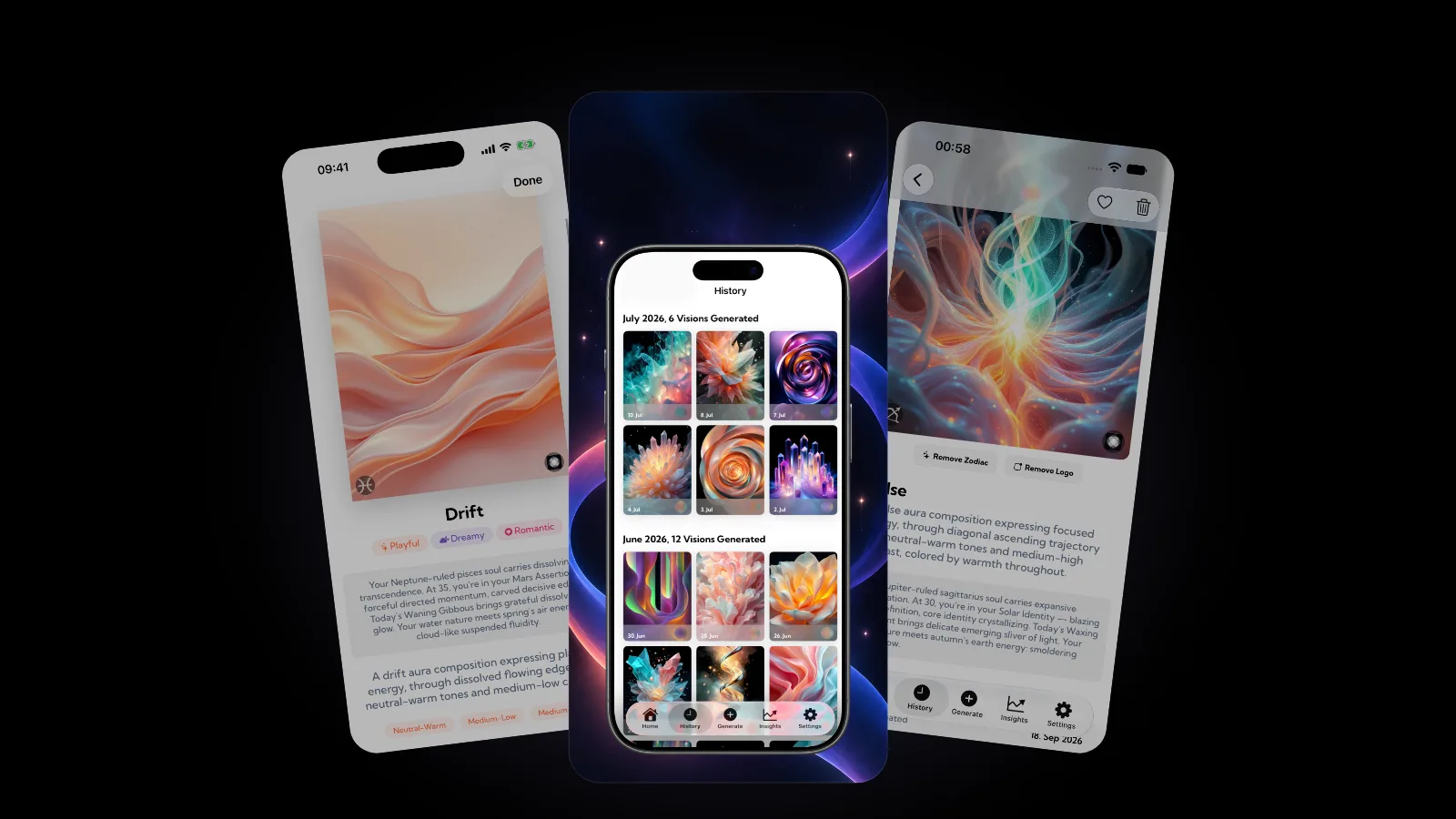
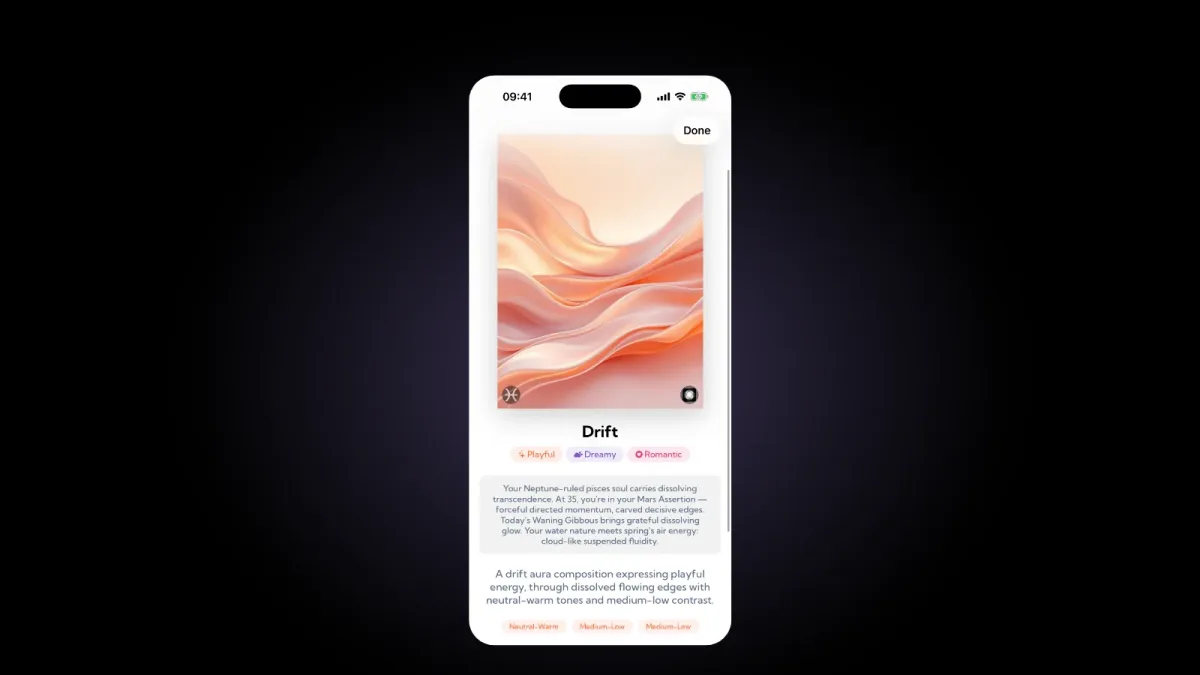
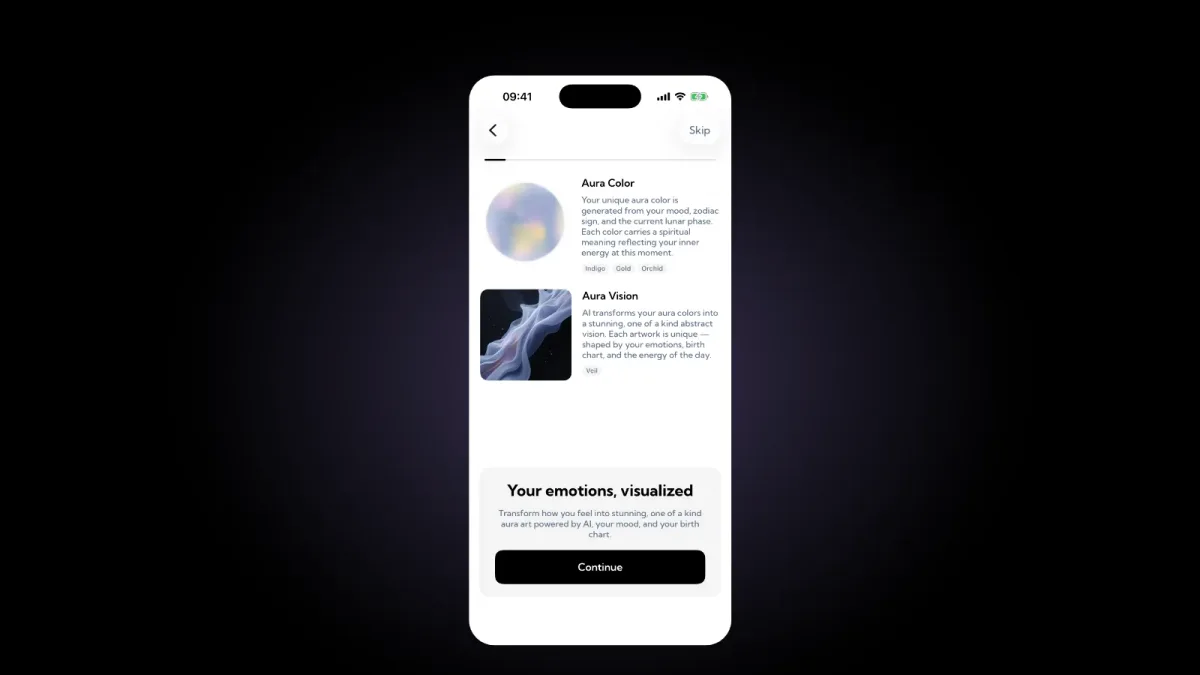
In Aura, Aura Portrait turns a photo into an AI self-portrait guided by your birth chart and personality. It doesn't read your skin or detect an energy field. It makes art. Aura Vision is the photo-free option: it creates a new, one-of-a-kind AI artwork from your mood and energy each day.
Both start from things you tell the app. You log your mood, choosing from 28 moods and up to three at once, and Aura reads your mood, your zodiac sign and the sky above to set your daily aura color. Your birth chart adds your sun, moon, rising sign and planetary placements; our guide to sun, moon and rising signs explains what each one stands for in astrology.
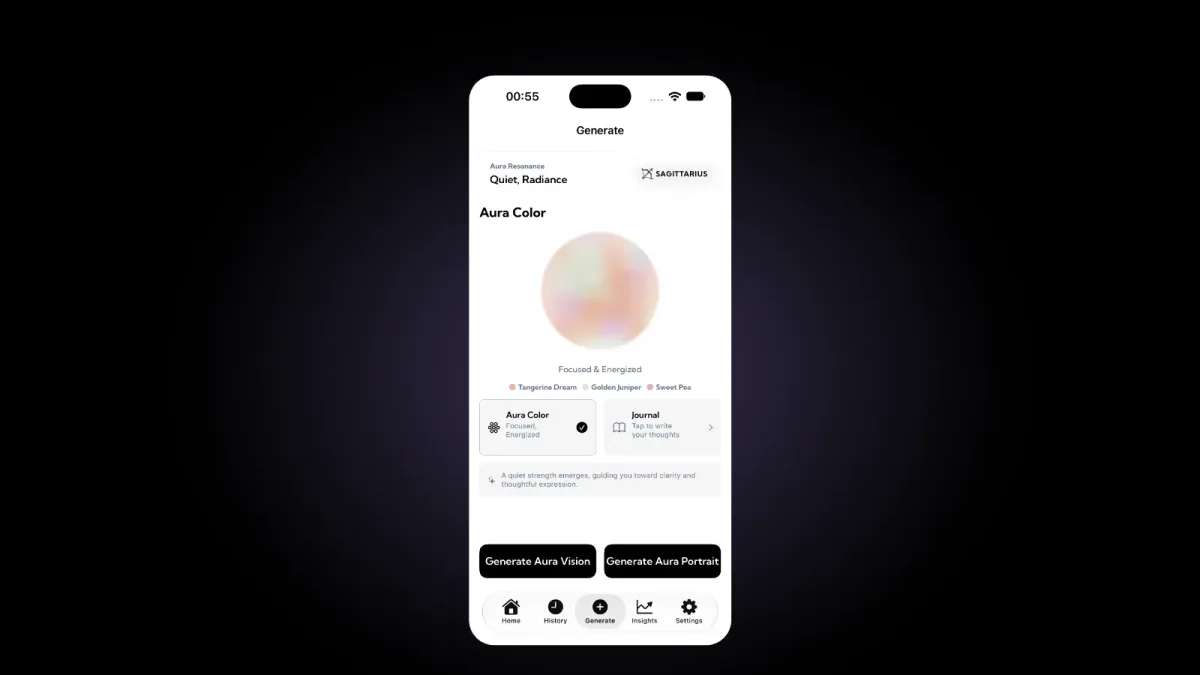
Aura Portrait and Aura Vision are part of Aura Pro, the optional subscription, along with your daily aura color and complete Aura Zodiac readings. The app itself is free to download and needs no account. Your mood history and journal stay on your device. You'll find more guides like this one in the Aura category of our blog.
FAQ
Are aura photos accurate?
They're accurate as photos and as a snapshot of your skin readings at that moment. They aren't accurate readings of an aura, because no instrument has detected one. The colors come from a software mapping, and NPR noted it's not clear how each color's meaning was decided.
Why does my aura photo change each time?
Because the inputs change. Skin conductance tracks arousal, so nerves, excitement or calm can shift the reading from one session to the next. The photographer in NPR's 2012 story said that trying to change a sitter's mood can affect the color of the portrait.
Can a phone camera capture an aura?
No. A phone camera records visible light, and no camera has been shown to capture an aura. Apps that make aura photos on a phone add the color with software, such as filters or AI. That can make lovely art, as long as it's presented as art.
What does a white or rainbow aura photo mean?
In aura tradition, white is read as clarity and a fresh start, and rainbow as sensitivity and a wide emotional range. Both are often called rare. Our guide to rare aura colors covers both, along with silver, gold and the darker shades.
Get started
If you'd like to see your mood as art rather than a printout, Aura is free to download on the App Store for iPhone with iOS 18.6 or later, with an optional Aura Pro subscription that includes Aura Portrait and Aura Vision. No account is needed.