AuraAura colors9 min read
Purple aura meaning: lavender, violet and deep purple
Purple aura meaning, shade by shade: what lavender, violet and deep purple are said to show, the purple aura personality, and if purple is rare.
A purple aura is traditionally read as intuition, imagination and a spiritual, inward-looking mood. Pale lavender leans gentle and dreamy, clear violet points to insight and inspiration, and deep purple or plum to wisdom and a rich inner life. These meanings come from spiritual tradition, not science, and work best as a prompt for reflection.
Purple is one of the core colors in our guide to aura colors meaning. This deep dive goes shade by shade and uses the same color language we built into Aura, our iPhone app that turns your mood into a daily aura color.
What does a purple aura mean?
A purple aura, in spiritual and New Age traditions, is a field of violet or purple light said to surround a person and reflect their inner state. It's the color most often tied to intuition, imagination and the spiritual side of life: a mood that looks inward and asks bigger questions. Readers describe purple days as reflective, dreamy or searching, the days you notice meaning in small things or want time alone to think. The shade changes the reading. Pale lavender is read as gentle sensitivity and daydreaming, clear violet as insight and inspiration, and deep purple or plum as wisdom and depth. A muddy, grayish purple is read as withdrawal or feeling misunderstood. Because purple sits between calm blue and warm red, many readers treat it as thinking with feeling behind it. Like every aura color, it's a symbol from tradition, not a measured fact about who you are.
That is tradition, not evidence: the encyclopedia entry on the aura in parapsychology says aura claims "are not supported by scientific evidence".
Where does the purple aura meaning come from?
Purple's meaning has three roots: physics, history and early 20th century spiritual writing. None proves anything about auras, but together they explain why purple feels deep and rare.
Start with the light itself. NASA's page on visible light says the human eye typically detects wavelengths from 380 to 700 nanometers, and that violet has the shortest, at around 380. Past it lies ultraviolet, which we can't see. Violet is the last color before the invisible, a fitting home for intuition.
Purple is different. The encyclopedia entry on purple explains that screens make it by mixing red and blue light, and that some authors call it a non-spectral color because it has no wavelength of its own. That mix fits the reading: blue's calm with some of red's warmth. Our guide to the blue aura meaning covers the calm half.
Then there's the dye. The entry on Tyrian purple cites a historian, drawing on a 1908 experiment, who wrote that twelve thousand sea snails yield no more than 1.4 grams of pure dye, "enough to colour only the trim of a single garment". By the fourth century AD, only the Roman emperor was permitted to wear it. The Purple entry adds that, according to contemporary surveys in Europe and the United States, purple is the color most often associated with "rarity, royalty, luxury, ambition, magic, mystery, piety and spirituality".
Aura writers took the spiritual side further. In "Man Visible and Invisible", whose 1903 edition is free on the Internet Archive, the Theosophist C. W. Leadbeater described "an exceedingly delicate violet" that showed "the capacity of love and devotion turned towards the highest ideal".
The crown chakra link is newer than it sounds. The encyclopedia entry on chakras lists the crown chakra, Sahasrara, as "White or Violet" in its table of New Age descriptions. But it says those rainbow colors are "not found in any ancient Indian system" and "were added by Leadbeater in 1927". It also says there is no scientific evidence that chakras exist. The same table makes the third eye indigo, a shade our guide to rare aura colors covers.
Lavender, violet or deep purple: what does each shade mean?
Shade changes the meaning most. The encyclopedia entry on lavender describes lavender as pale purple "on the blue side", while lilac is "pale purple on the pink side". The readings below are a modern synthesis, not fixed rules.
| Shade | Traditional reading | Mood words |
|---|---|---|
| Lavender (pale, bluish purple) | Gentle sensitivity, imagination, a soft spiritual side | Dreamy, tender, calm |
| Lilac (pale, pinkish purple) | Compassion with a reflective edge | Hopeful, soft, nostalgic |
| Violet (clear and bright) | Insight, inspiration, spiritual connection | Reflective, inspired, curious |
| Royal purple (rich, medium) | Wisdom, vision, quiet confidence | Thoughtful, assured, focused |
| Plum or deep purple (dark, reddish or brownish) | Depth, mystery, a strong inner life | Introspective, intense, private |
| Muddy or grayish purple | Withdrawal, feeling misunderstood, mental fatigue | Lonely, foggy, tired |
Lavender aura meaning
A lavender aura is read as gentleness with imagination: a sensitive, soft-spoken mood that drifts toward daydreams, music or art. A thin, washed-out lavender is read as feeling fragile or too open to other people's moods.
Violet aura meaning
Violet is purple at its clearest, read as insight and inspiration. It's the shade linked with sudden understanding, creative ideas and a sense of connection to something larger.
Dark purple aura meaning
Deep purple and plum are read as depth: wisdom, intensity and an inner life you keep mostly to yourself. Closest to old royal purple, it also carries quiet authority. When it turns muddy or brownish, it's read as heavy thoughts or pulling away from people.
Lilac's pink side overlaps with our pink aura meaning guide. If purple appears next to a separate pink or blue, our guide to aura color combinations reads those pairs.
What are people with a purple aura said to be like?
People with a purple aura are said to be intuitive, imaginative and thoughtful: the friend who asks the question nobody else thought of. Common traits:
- Intuitive. They pick up on what goes unsaid.
- Imaginative. Art, music, stories and daydreams come easily.
- Reflective. They need time alone to think things through.
- Big-picture. They ask why, not only how.
- Empathic. Other people's feelings register quickly, sometimes too quickly.
The traditional shadow side is drifting: living in your head, putting off practical things or feeling misunderstood. Since most traditions say aura colors shift with your mood, purple often describes a phase, not a fixed personality.
Is a purple aura rare, and is it good or bad?
A purple aura isn't rare in aura guides. It belongs to the basic palette with red, orange, yellow, green, blue and pink. Auras can't be detected, so nobody knows how often any color appears. Purple feels rare because of its history: the Tyrian purple entry quotes a fourth century BC historian who reported that purple for dyes "fetched its weight in silver". Your own rare color is simply the shade that turns up least in your record.
Is it good or bad? Mostly good. In 2020, the journal Psychological Science published Universal Patterns in Color-Emotion Associations Are Further Shaped by Linguistic and Geographic Proximity, a survey of 4,598 people from 30 nations. Most color and emotion links were widely shared. In a 2022 summary, two of the authors wrote that purple was "generally a positive color" with "very little agreement" on which emotions it carries. Only Greek participants linked it with sadness. Their verdict: "purple was the most controversial color of all!"
How can a purple day in your mood journal help you reflect?
Since purple stands for reflection, a purple day is a good cue to write. Pick one or two prompts:
- What did I notice today that I usually miss?
- Which hunch did I have, and what was it based on?
- What am I imagining or hoping for right now?
- Which question keeps coming back to me?
- Do I need more time alone this week, or less?
On a muddy purple day, try a gentler one: where do I feel misunderstood, and who could I explain it to? A few lines are enough. Over weeks, you'll see what tends to come before your purple days.
Aura colors are a prompt for reflection, not medical or psychological advice. If you feel low or withdrawn for weeks, talk to a doctor.
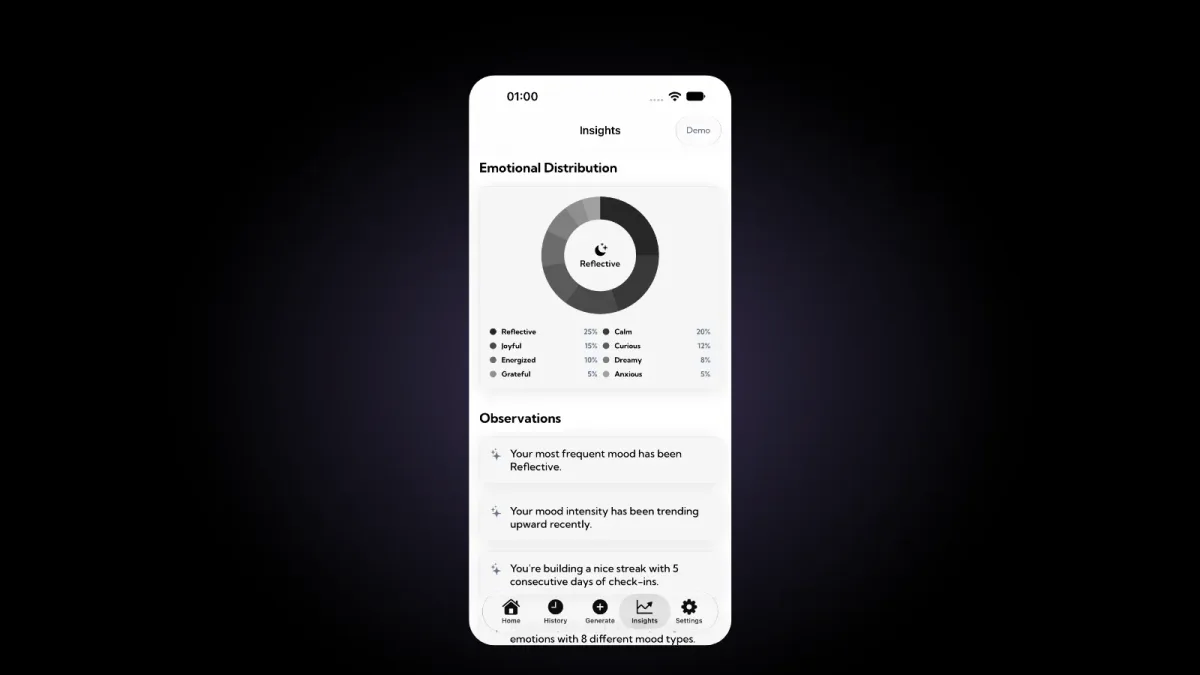
How does Aura show purple in your daily aura color?
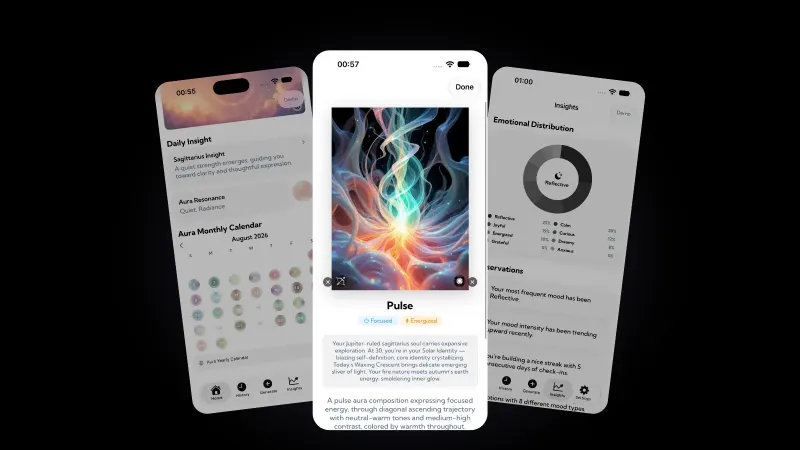
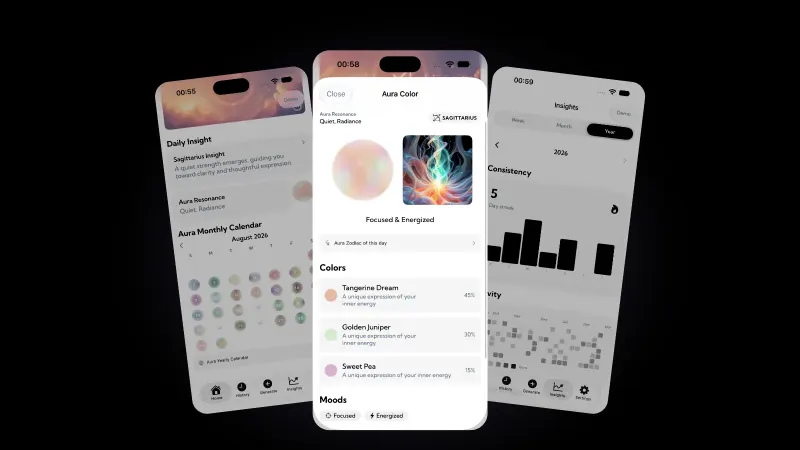
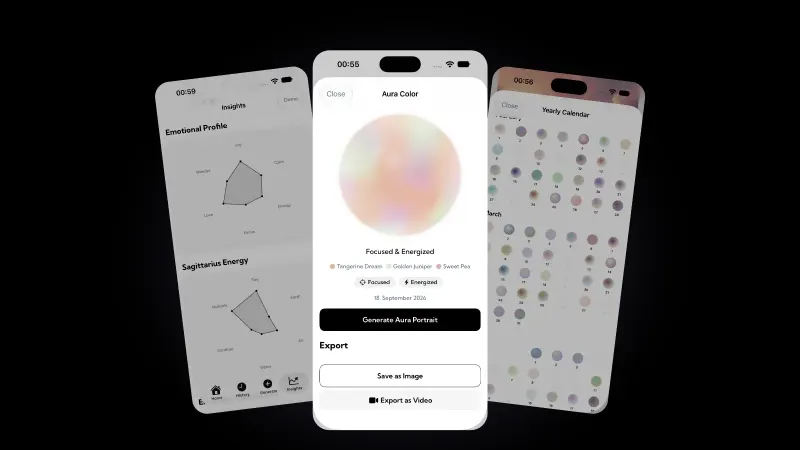
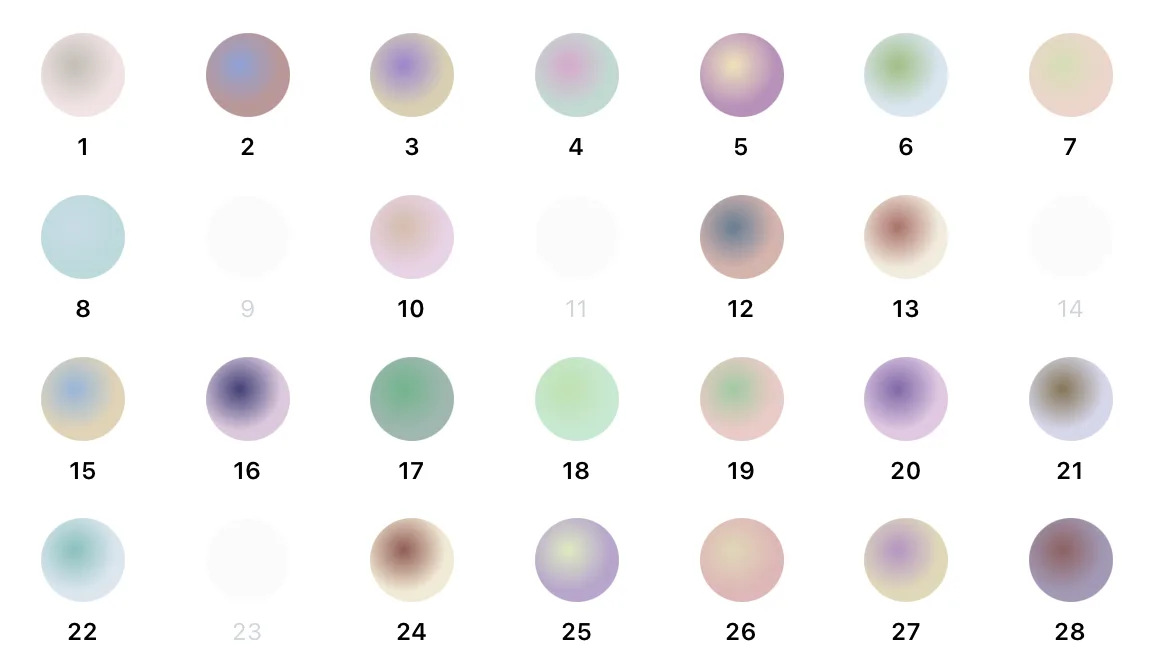
In Aura, you log your mood, choosing from 28 moods and up to three at once. Every day the app reads your mood, your zodiac sign and the sky above to reveal your aura color, which is part of Aura Pro. Each reading names its colors and shows how much of the reading each one takes as a percentage. Aura doesn't see or measure an aura; it turns your mood, your sign and the sky into color.
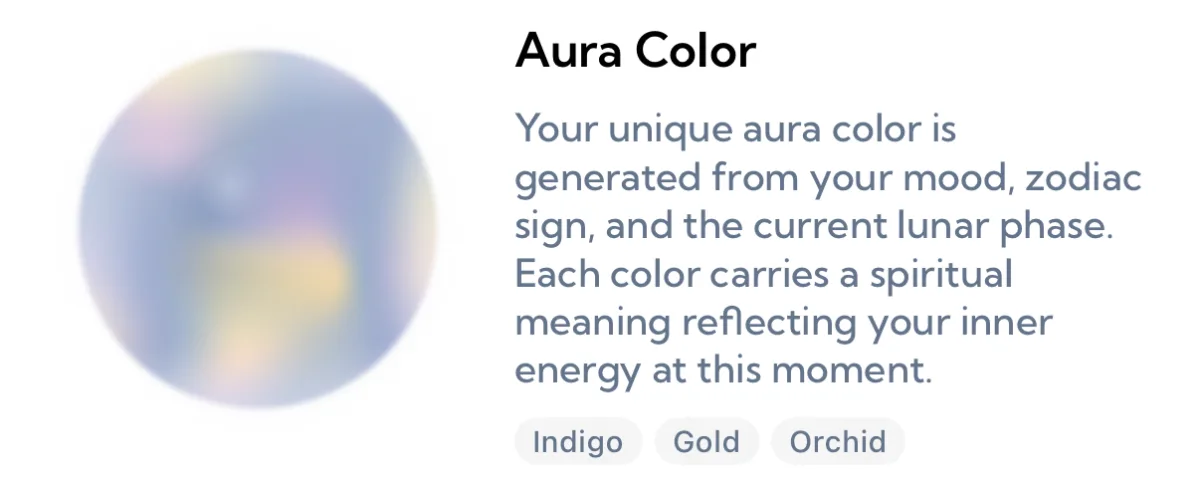
Read the names as well as the swatches: Orchid is a purple-family name, and Indigo sits between blue and violet. The color families are our reading, not something the app states. Over time, your colors fill a calendar of your emotional year, so you can count your purple days. You can find more posts like this in the Aura category of our blog.
FAQ
Is a purple aura rare?
No. Purple is a basic aura color, and auras can't be counted, so "rare" is tradition, not data. The reputation comes from history: in a 1908 experiment, twelve thousand sea snails yielded no more than 1.4 grams of Tyrian purple dye.
Is a purple aura good or bad?
Mostly good. Purple is read as intuition, imagination and wisdom. Only a muddy or grayish purple is read as withdrawal or tiredness, and that describes a moment, not a flaw. In a 30-nation survey, purple was generally positive, though people agreed least on which emotions it carries.
What does a dark purple aura mean?
Dark purple, plum or deep violet is read as depth, wisdom and a strong, private inner life, close to the old royal purple. If it looks muddy or brownish, readers take it as heavy thoughts or withdrawal, a sign to rest and talk to someone you trust.
Can your aura turn purple?
In most traditions, yes. Aura colors are said to shift with your mood, so a purple day can follow a yellow one. Reflective, dreamy or searching moods are the ones usually read as purple. Auras can't be measured, so treat the change as a description of how you feel.
Get started
Curious how often purple turns up for you? Aura is free to download on the App Store for iPhone, with an optional Aura Pro subscription that includes your daily aura color. No account is needed, your mood history and journal are stored on your device, and your data is never sold.