AuraAura colors9 min read
Blue aura meaning: light blue, dark blue and royal blue
Blue aura meaning: what light, royal and dark blue are said to show, the blue aura personality, its shadow side, and how it differs from turquoise.
A blue aura is traditionally read as calm, honesty and clear communication. Light blue points to peace and gentle honesty, royal blue to confident self-expression, and dark blue to depth, loyalty and devotion. A muddy or grayish blue is read as sadness or holding back. These meanings come from spiritual tradition, not science.
Blue is one of the core colors in our guide to aura colors meaning. This post looks at it up close, including why the same color means calm in aura reading and sadness in everyday English. It uses the color language we built into Aura, our iPhone app that turns your mood into a daily aura color.
What does a blue aura mean?
A blue aura, in spiritual and New Age traditions, is a field of blue light said to surround a person and reflect their mood. It's the color of a quieter state: calm, trust, honesty and the wish to say what you mean. Readers link it to the throat and to communication, so a blue day is often read as a day for listening well and speaking plainly. The shade changes the reading. Light blue is peace and ease. Royal blue is clear, confident expression. Dark blue is depth, loyalty and a more serious, devoted mood. Gray or muddy blue is read as sadness, worry or words held back. Most traditions say the color shifts with your mood, so a blue aura describes a day or a phase, not a fixed personality. Science has found no evidence that auras exist, so treat blue as a vocabulary for how you feel.
The encyclopedia entry on the aura in parapsychology says such claims are "not supported by scientific evidence", and that tests of people who say they can see auras "have repeatedly been met with failure".
Why does blue mean calm in aura reading but sadness in everyday speech?
Because the two meanings come from different places. In everyday English, blue stands for low spirits: people feel blue or get the blues. Aura tradition took the color somewhere else.
In 2020, the journal Psychological Science published Universal Patterns in Color-Emotion Associations Are Further Shaped by Linguistic and Geographic Proximity, a study by an international team of 36 researchers. Its abstract opens with the idiom itself: "Many of us 'see red,' 'feel blue,' or 'turn green with envy.'" The team asked 4,598 people from 30 nations, speaking 22 native languages, to link 20 emotion concepts with 12 color terms.
The study found universal color and emotion associations, with an average similarity coefficient of .88. Still, nation predicted the links "above and beyond" the universal ones, and countries closer in language or geography matched more closely. In its write-up, Seeing red or feeling blue?, BPS Research Digest gives two examples: Chinese participants linked white with sadness as well as relief, and Greeks linked purple with sadness, while other nationalities mostly linked purple with positive emotions.
So a color can carry a shared meaning and a local one at once. The calm, honest blue of aura reading has a history of its own.
That tradition runs through the Theosophist C. W. Leadbeater. In Man Visible and Invisible (1903 edition on the Internet Archive), he wrote that "Dark, clear blue usually indicates religious feeling", and that "Light blue, such as ultramarine or cobalt, shows devotion to a noble spiritual ideal". Light blue, he added, can rise to "a luminous lilac-blue, which indicates the higher spirituality". For Leadbeater, blue was the color of devotion.
Modern chakra charts add the link to speech. They give blue to Vishuddha, the throat chakra, which the encyclopedia ties to self-expression and "the action of speaking". The entry on chakras notes that the seven rainbow colors were added by Leadbeater in 1927, and that there is no scientific evidence chakras exist.
Here's how we square the two meanings. Both describe a slower, quieter state. Calm is quiet that feels restful. Sadness is quiet that feels heavy. A blue day simply asks which one you're in.
Light blue, royal blue or dark blue: how do the shades differ?
Most guides read blue by its shade first. Here's how the common shades are usually read.
| Shade | What it looks like | Traditional reading | Shadow reading |
|---|---|---|---|
| Light blue | Sky, powder or baby blue | Peace, ease, gentle honesty | Shyness, keeping quiet to keep the peace |
| Royal blue | Vivid, saturated mid blue | Clear self-expression, confidence, loyalty | Rigid views, needing the last word |
| Dark blue | Navy or deep midnight blue | Depth, devotion, loyalty, careful thought | Withdrawal, a heavy or low mood |
| Gray or muddy blue | Dull, smoky or slate blue | A tired voice that needs rest | Sadness, worry, words held back |
Light blue aura meaning
Light blue is the gentlest blue. It's read as peace and ease: a settled mind, honest but kind words and a day without much friction. Its shadow reading is staying quiet just to avoid conflict.
Royal blue aura meaning
Royal blue is vivid and saturated. Most modern guides read it as confident self-expression: knowing what you think and saying it clearly. The shadow side is a voice that turns rigid, more interested in being right than in being heard.
Dark blue aura meaning
Dark blue, or navy, is the most serious blue. It's read as depth, loyalty, devotion and careful thought, the mood of someone who weighs every word. Leadbeater's main entry is about this shade: dark, clear blue for religious feeling, which he said "varies immensely according to the type of the feeling". Clear navy is depth. Cloudy, heavy navy is read as withdrawal. Dark blue that leans toward violet becomes indigo, and our purple aura meaning guide covers that side.
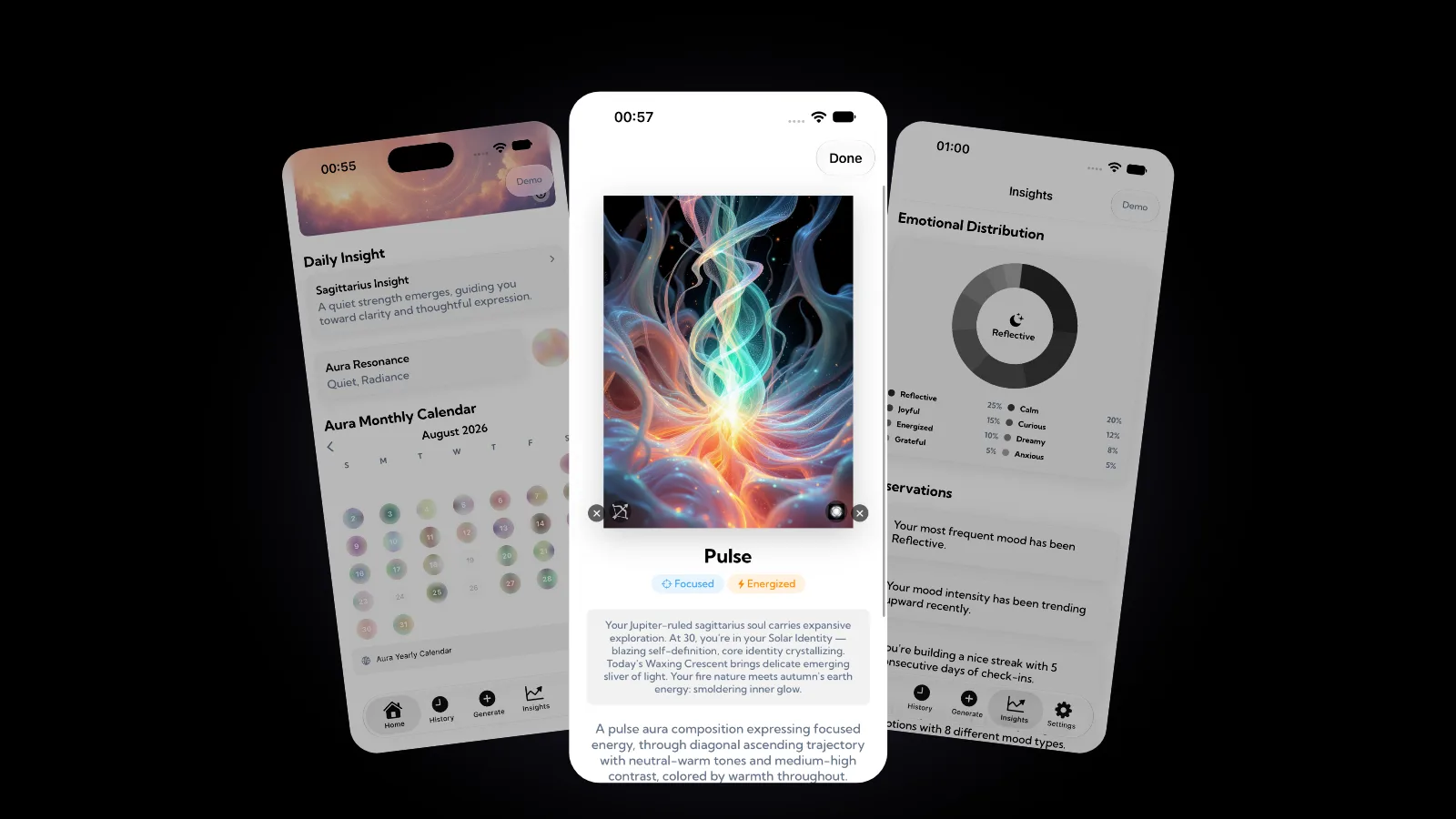
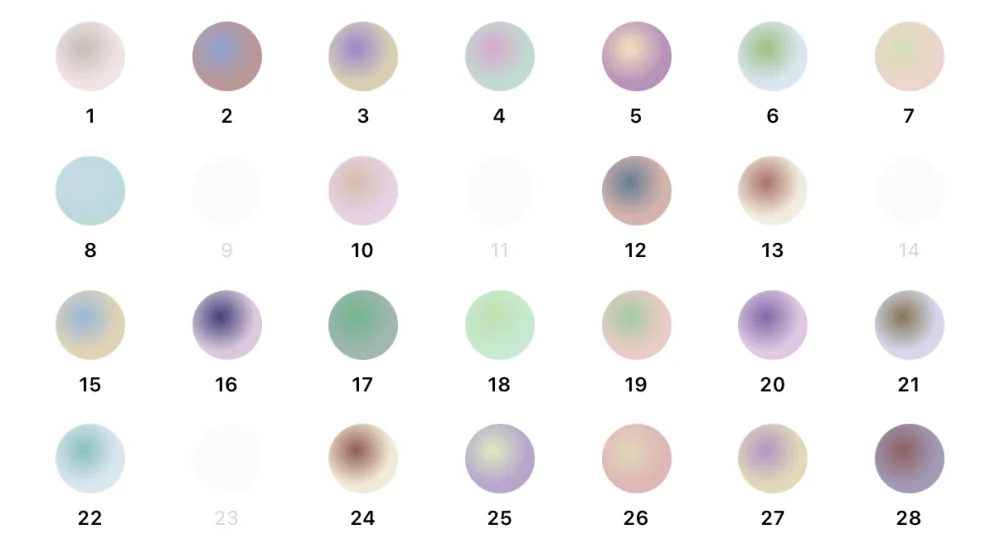
Shades drift from day to day, too. Here's one month from Aura's Yearly Calendar.
What are people with a blue aura said to be like?
People with a blue aura are described as calm, honest and steady: the friend who listens before answering. Common blue aura traits include:
- Calm. They stay level when a room gets loud.
- Honest. They'd rather say a kind, true thing than a comfortable, false one.
- Loyal. Trust matters to them, and they keep it.
- Good listeners. People tend to tell them things.
- Careful with words. They think before they speak, sometimes for too long.
- Private. They may keep their own feelings to themselves.
Blue rarely shows up alone. Next to purple, it's read as calm insight, and next to green, as steady, honest care. Our guide to aura color combinations covers those pairs and more.
Can a blue aura mean something negative?
Yes, but most readings blame the shade, not the color. Clear blue is one of the most positive aura colors. Gray, smoky or muddy blue is read as sadness, worry, loneliness or a voice you're holding back.
Does a blue day mean something is wrong? No. It's a cue to check whether your quiet feels like rest or like weight.
Aura colors are a prompt for reflection, not medical or psychological advice. The NHS page on low mood, sadness and depression says a low mood often gets better after a few days or weeks, but one that lasts two weeks or more could be a sign of depression. If that sounds like you, talk to a doctor or another health professional.
What can blue days in a mood journal show you?
A run of blue days shows how much of your week is quiet. In aura terms, calm days and low, heavy days can both read as blue, so the color alone won't tell you which.
Naming the exact feeling helps. Our emotion wheel guide shows how to move from a broad word like sad to a sharper one like lonely or tired. On a blue day, try three questions:
- Does this quiet feel restful or heavy?
- Is there something I want to say and haven't?
- What happened right before my mood shifted?
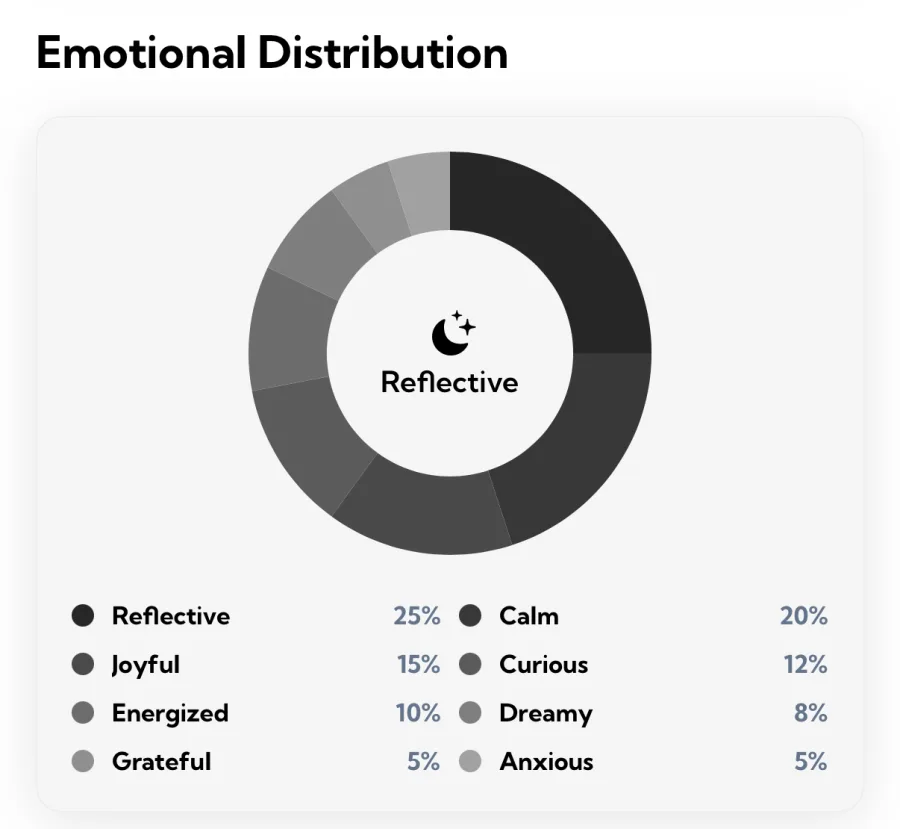
Over several weeks, your moods say more than any single day. Aura's Insights screen charts your most frequent moods, your streaks and how your energy shifts over time. In this example, Calm makes up a fifth of the logged moods.
How does Aura show blue in your aura color?
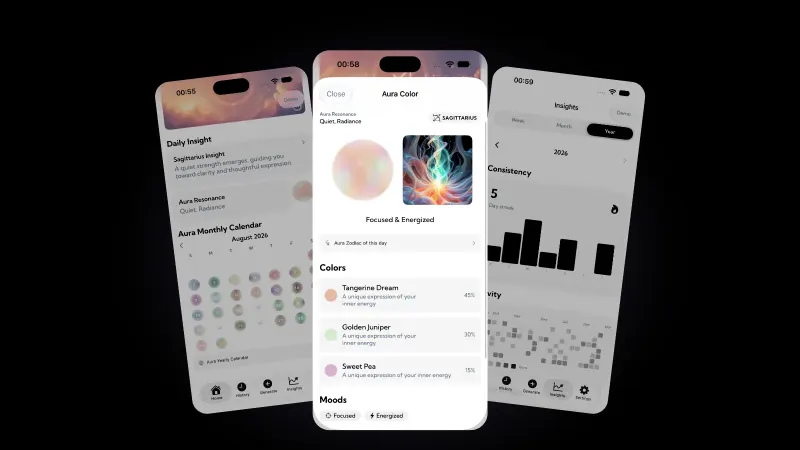
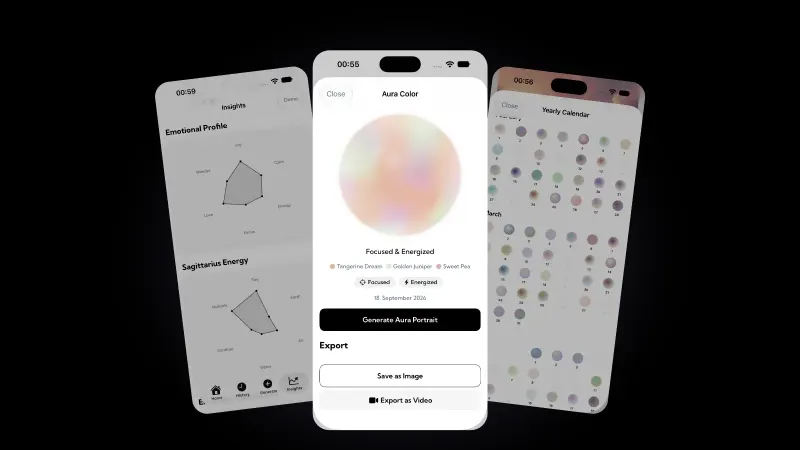
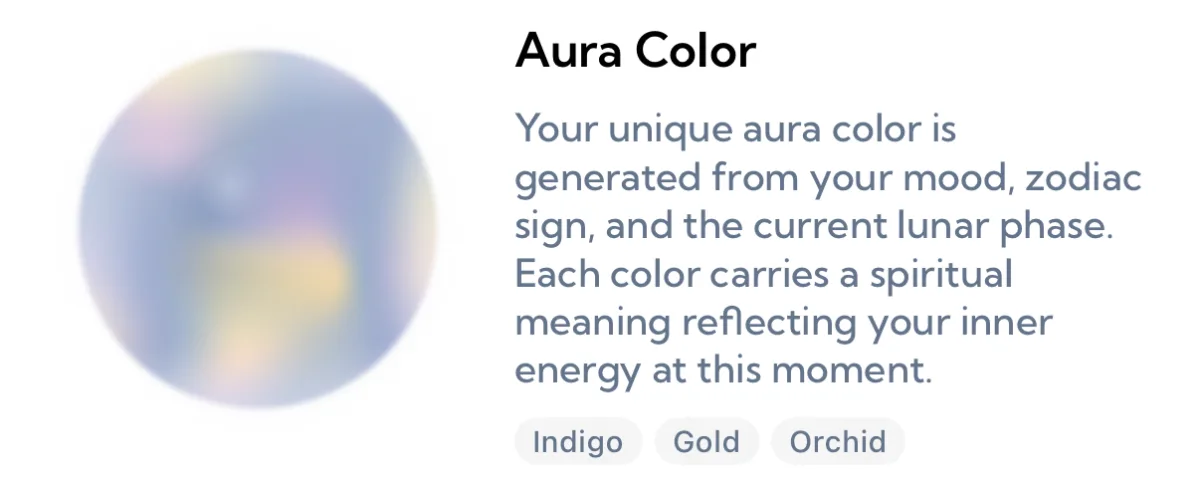
In Aura, you log your mood, choosing from 28 moods and up to three at once, and you can add a journal entry. Every day the app reads your mood, your zodiac sign and the sky above to reveal your aura color, which is part of Aura Pro. Each reading names its colors, your colors fill a calendar of your emotional year, and you can explore what each color means.
One tip: read the swatch as well as the name. A color called Indigo sits between blue and violet, so we'd read it with both meanings in mind.
Curious how your sign fits in? See our guide to aura color by zodiac sign. You can find more posts like this in the Aura category of our blog.
FAQ
What does a light blue aura mean?
A light blue aura is read as peace, ease and gentle honesty: a settled, open mood. In Leadbeater's 1903 book, light blues such as ultramarine and cobalt showed devotion to a noble spiritual ideal. Its shadow reading is shyness, or keeping quiet to keep the peace.
What does a dark blue aura mean?
A dark blue aura is read as depth, loyalty, devotion and careful thought. Clear navy is a positive, serious shade. Cloudy or heavy navy is read as withdrawal or a low mood, a cue to check in with yourself rather than a verdict on who you are.
Is a blue aura good?
Yes, in most traditions. Clear blue is linked to calm, trust and honest communication, and it's one of the most positive aura colors. Only gray or muddy blue gets a negative reading, usually sadness or words held back. Like every aura color, it describes a moment, not your worth.
Is a blue aura the same as turquoise?
No. Turquoise blends blue with green, so it adds empathy and healing to blue's calm. Most guides treat it as its own, less common shade. Our guide to rare aura colors covers turquoise, indigo and other in-between colors.
Get started
Want to see how often blue turns up for you? Aura is free to download on the App Store for iPhone, with an optional Aura Pro subscription that includes your daily aura color. No account is needed, and your data is never sold.