PosturaHabits9 min read
How long does it take to form a habit? What studies show
How long does it take to form a habit? Often about two months, not 21 days. What a 2010 UCL study and a 2024 review found, and how to make one stick.
It usually takes about two months for a new habit to feel automatic, not 21 days. A 2010 University College London study found a median of 66 days, with individuals ranging from 18 to 254 days. A 2024 review of 20 studies found medians of 59 to 66 days and a range of 4 to 335.
This guide explains where the 21-day idea falls short, why one missed day doesn't send you back to the start, and how to build a 30-second desk habit that lasts. The worked example is Postura, our app for posture checks and stretch breaks, which tracks streaks and consistency. This is general information, not medical advice.
How long does it take to form a habit?
Plan on two to five months for a simple daily habit, and expect your own timeline to differ from anyone else's. In 2010, a University College London study in the European Journal of Social Psychology followed 96 volunteers for 12 weeks. Each chose one eating, drinking or activity behavior to repeat daily in the same context, such as after breakfast, and rated each day how automatic it felt. The median time to reach 95% of their peak automaticity was 66 days, with individual times from 18 to 254 days. In 2024, a systematic review and meta-analysis in Healthcare pooled 20 studies with 2,601 participants. Four reported times to habit formation: medians of 59 to 66 days, means of 106 to 154 days and individual times from 4 to 335 days. Its authors advise expecting "at least two to five months" rather than "the commonly cited 21-day period."
Researchers call a formed habit automatic: the cue appears and you start without weighing it up.
| Source | What was studied | Typical time | Individual range |
|---|---|---|---|
| The 21-day rule | Popular culture, not a study | 21 days | Not measured |
| UCL study, European Journal of Social Psychology, 2010 | 96 volunteers, one daily eating, drinking or activity habit, 12 weeks | Median 66 days | 18 to 254 days |
| Review and meta-analysis, Healthcare, 2024 | 20 studies, 2,601 people, habits such as activity, diet and flossing | Medians 59 to 66 days, means 106 to 154 days | 4 to 335 days |
Is it really 21 days to form a habit?
No. The 21-day rule has no solid research basis. The 2024 review traces it to a popular book rather than a study, and notes that the timeline "has been questioned." Its authors are blunt: "Brief 21-day challenges or kickstarts are unlikely to be sufficient to firmly ingrain new habits."
Three weeks isn't impossible. The fastest person in the 2010 study got there in 18 days. But 66 days was the median, so half the group took longer than that. If a habit still takes effort on day 22, you haven't failed. You're on a normal schedule.
What did the 66-day study actually find?
The study measured how automatic a habit felt, not just whether people did it. Of the 96 volunteers, 82 gave enough data to analyze. Each day they filled in the self-report habit index, a standard questionnaire on habit strength.
Three findings matter for anyone starting a routine:
- Automaticity rises on a curve. Early repetitions add the most. Later ones add less, until the habit levels off.
- Consistency helps. People who performed the behavior more consistently fitted the habit curve better.
- Long times are projections. The study lasted 84 days, so times like 254 days were projected from each person's curve.
That third point is easy to miss. Nobody watched a habit form over 254 days; the curve suggested it was still climbing. Some habits are slow, and that's fine.
Does missing a day break a habit?
No. In the 2010 study, "missing one opportunity to perform the behaviour did not materially affect the habit formation process." One gap doesn't reset you to day one. Overall consistency over weeks matters far more than a perfect record.
So treat a missed day as a gap, not a verdict. Do the habit at your next usual cue and carry on. It also helps to plan for days that won't go to plan. In Postura, a day mode changes how much you hear from the app: Busy Day sends fewer reminders, Meeting-Heavy keeps interruptions minimal and Silent Day sends none. Day modes reset at midnight, so tomorrow starts normally.
What makes a habit form faster?
Repetition in a stable setting, mostly. The 2024 review lists frequency, timing, type of habit, individual choice and affective judgements, meaning how much you enjoy it, among the factors that influence habit strength. Here's what the studies it covers point to:
- Repeat it often. The review cites studies where more frequent practice sped up habit formation.
- Keep the same time and place. People who repeated a behavior in a consistent context built stronger habits.
- Try the morning. In one study, a daily stretching habit took a mean of 106 days to form in the morning and 154 days in the evening.
- Choose it yourself. Habits people picked themselves did better than ones they were assigned.
- Make it pleasant. In one physical activity study, enjoying the activity was linked to stronger habit formation.
- Plan the details. In that same study, planning exactly when and where, and preparing in advance, were linked to it too.
The cue type mattered less than you might think. One study in the review found no significant difference between a time cue, like a glass of water at 9:00 a.m., and a routine cue, like water after breakfast. Pick whichever you'll notice every day.
How do you build a small desk habit that sticks?
Start smaller than feels useful. The review notes that simple, repetitive behaviors with clear cues and immediate rewards are easier to automate, and a 30-second desk habit fits that description. Here's a method that follows the research:
- Pick an anchor cue. Habit stacking means linking a new habit to something you already do. After you sit down with your first coffee, do a posture check.
- Keep it to 30 seconds. A habit that small survives busy days.
- Use the same time each day. Repeat the same cue at the same moment, every working day.
- Track it gently. Tick it off, look at the week and ignore single misses.
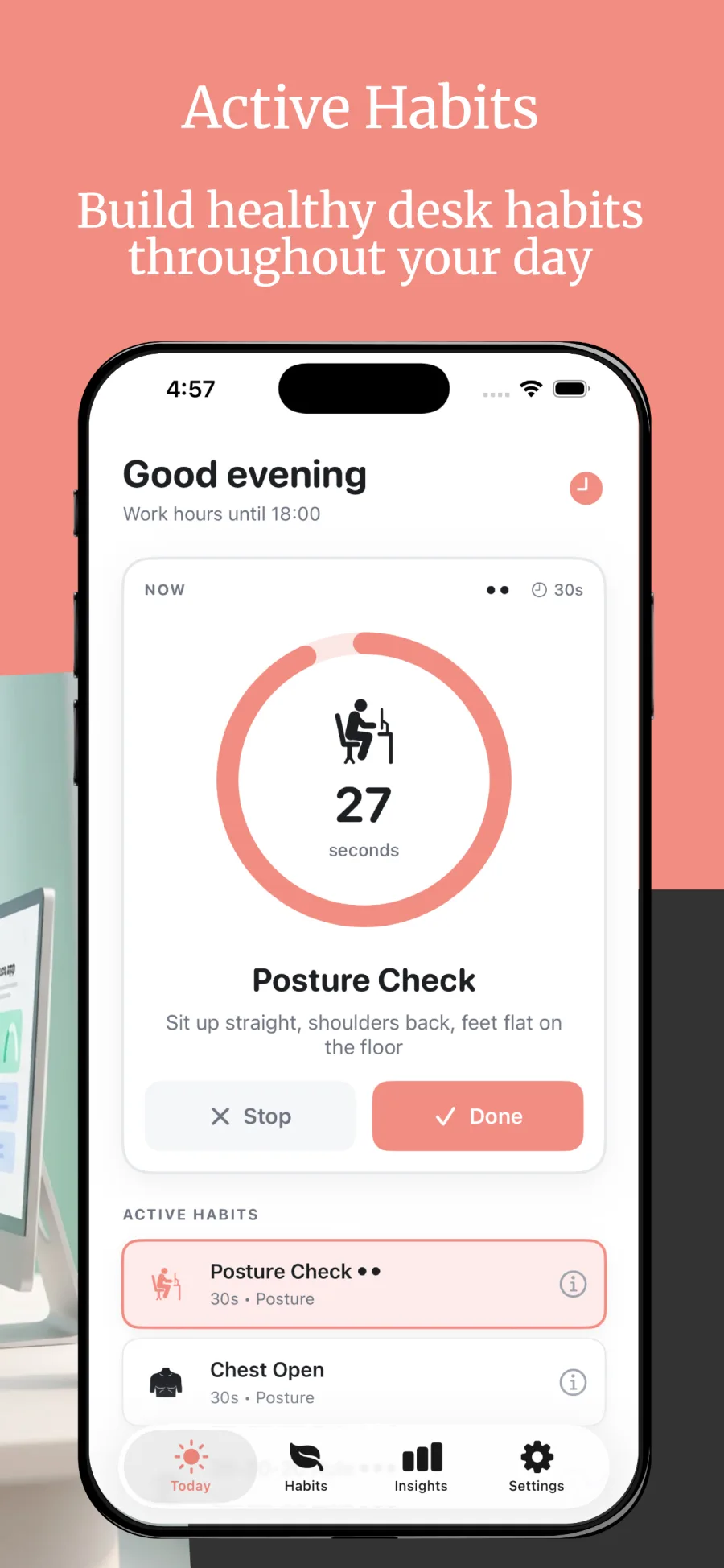
Postura is built around this pattern. Each habit has a daily target, and the app's own hint is "Most people start with once a day." Posture Check takes 30 seconds: sit up straight, shoulders back, feet flat on the floor. Reminders follow your working hours and active days. When one arrives, you can mark the habit done or snooze it for 15 minutes from the notification. On iPhone, the Pause when completed setting stops reminders once you meet the day's goal.
Which habit should come first? If you slouch, start with how to stop slouching. For more ideas, see our list of micro breaks at work, or try 40 seconds of box breathing. To set up prompts on your phone, see posture reminders on iPhone.
Do streaks and habit trackers help?
Probably, but the evidence on streaks themselves is thin. A 2024 systematic review in the Journal of Medical Internet Research looked at 41 studies of digital tools for physical activity. The most used techniques were self-monitoring, goal setting, and prompts and cues. Virtual rewards such as points and badges appeared in 16 of the 41 studies, but only 2 tested whether rewards worked.
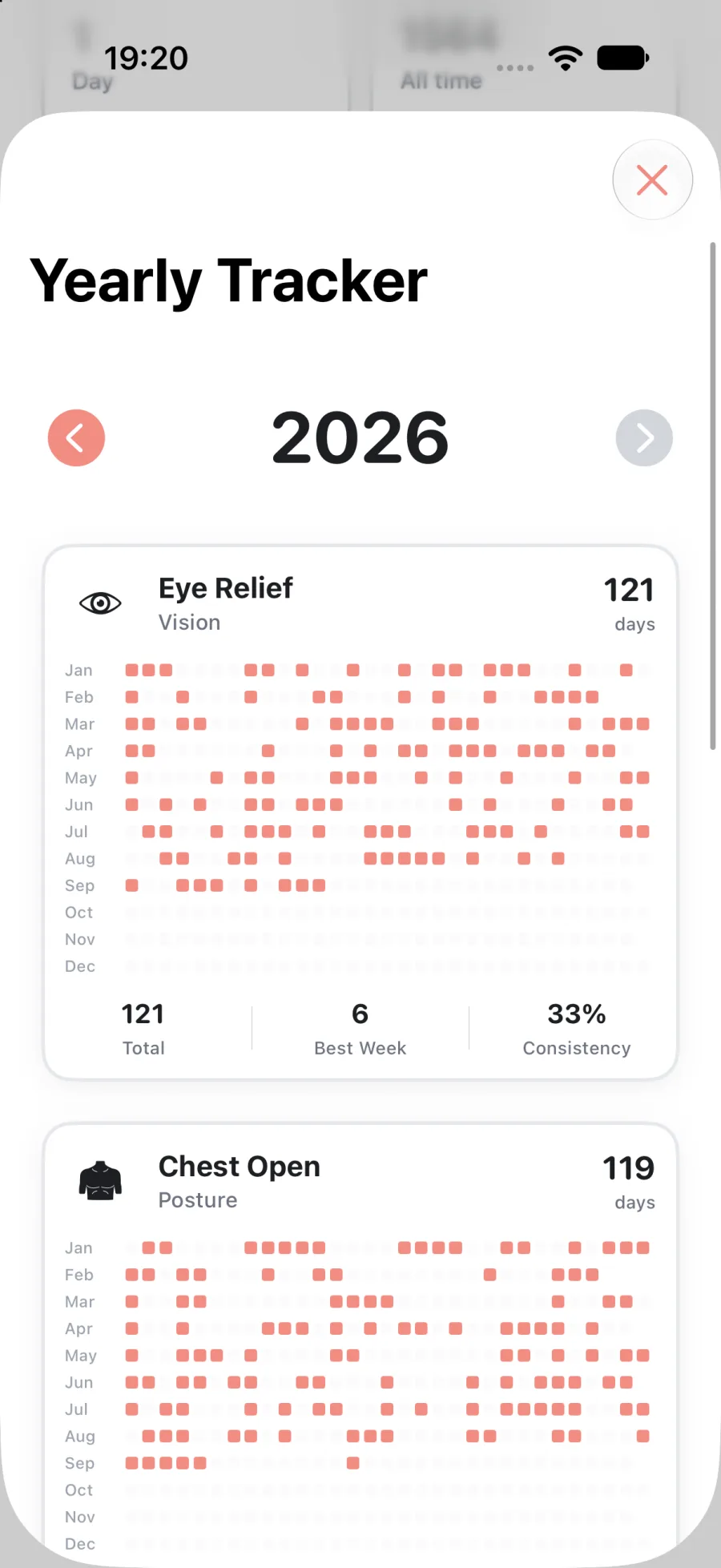
So use a streak as feedback, not as a test. Since a single missed day didn't derail the 2010 participants, a broken streak isn't a broken habit. Longer views are more honest: a month of bars or a year of squares shows the trend that one missed Tuesday hides. It's the same idea as a year in pixels mood tracker, one square per day.

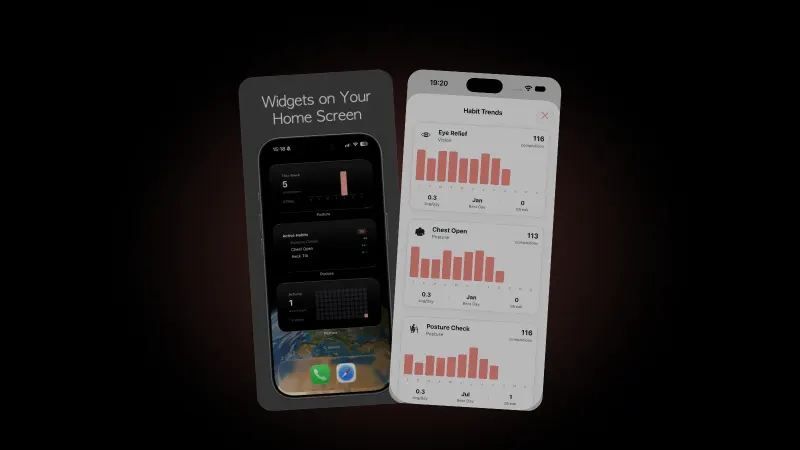
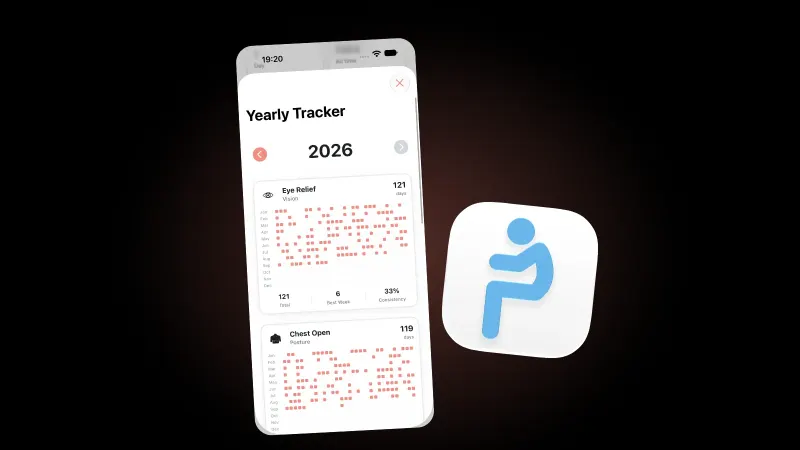
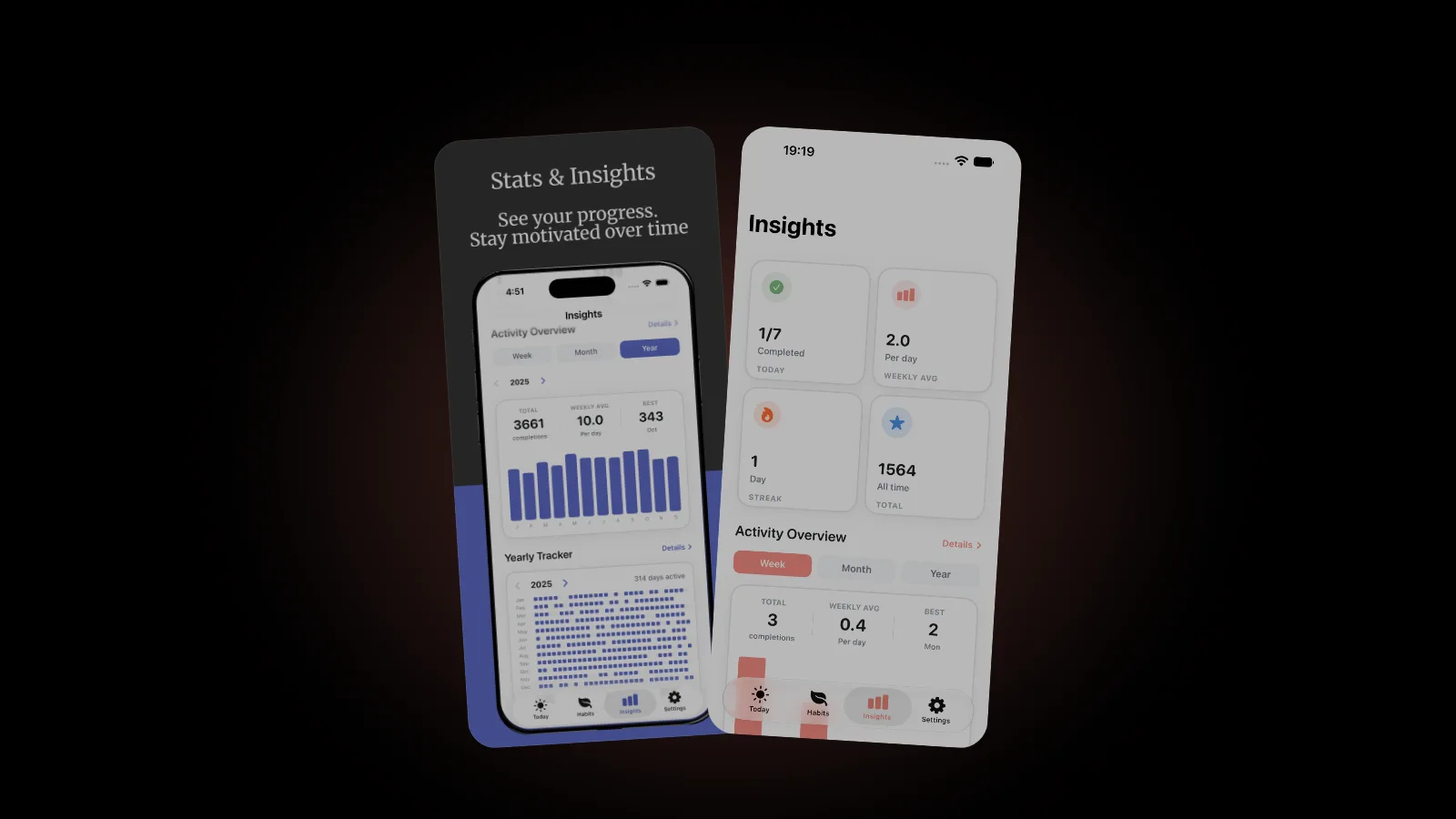
On iPhone, Postura's Insights tab opens with four cards: today's completions, your weekly average, your current streak and your all-time total. Habit Trends and the Yearly Tracker are part of Postura Pro. On the iPhone Home Screen, the Active Habits widget is free, while the Weekly Activity and Activity Heatmap widgets come with Pro.
FAQ
Is 66 days the magic number for a new habit?
No. It's the median from one 2010 study of 96 people, so half took longer. Individual times ran from 18 to 254 days, and the 2024 review found a range of 4 to 335 days across studies. Use two months as a rough checkpoint, then judge by how automatic the habit feels.
How do you know when a habit has formed?
When the cue appears and you start without deciding to. Researchers measure this with questionnaires such as the self-report habit index, which asks how automatic a behavior feels. In the 2010 study, automaticity rose fast at first and then leveled off. If the habit still needs willpower, keep repeating it.
Do habits form faster in the morning?
Possibly. The 2024 review reports that morning practices generally showed greater habit strength. In one study it covers, a daily stretching habit took a mean of 106 days to form in the morning and 154 days in the evening. That's one behavior in one study, so treat it as a hint, not a rule.
How long does it take to build a routine?
Longer than a single habit, because a routine is several habits in a row. Each step needs its own repetition in a stable context. The 2024 review notes that simpler, repetitive behaviors with clear cues are easier to automate, so build one short step at a time and add the next once the first feels easy.
Get started
Postura is free to download on the App Store for iPhone and Apple Watch, and on Google Play for Android, with an optional Pro subscription. Pick one 30-second habit, set it for once a day and let the reminders handle the remembering. Postura is not a medical app; it is a gentle way to build better desk habits. See everything it does on the Postura page or read more Postura articles.