
PlateNutrition8 min read
How to calculate calories in a recipe, per serving
How to calculate calories in a recipe: weigh each ingredient, add up the calories and divide by servings. A worked USDA example and the raw vs cooked trap.

To calculate calories in a recipe, weigh every ingredient, look up its calories per 100 grams, and multiply by the weight you used. Add those numbers for the whole recipe, then divide by the number of servings. If portions are uneven, weigh the finished dish and work out calories per gram instead.
We make Plate, an AI recipe keeper for iPhone that estimates nutrition ingredient by ingredient. This guide shows the method by hand, a worked example with USDA data, the mistakes that skew the result, and how Plate runs the same sum for you.
This is general cooking information, not medical or dietary advice; for a health condition or specific needs, follow a doctor or registered dietitian.
How do you calculate calories in a recipe?
Calculating calories in a recipe means adding up the energy in every ingredient and sharing it across the portions. Start by weighing each ingredient in grams as it goes into the pan, including the oil, butter and sugar that are easy to forget. Next, look up each ingredient's calories per 100 grams in a food composition database such as USDA FoodData Central, or on the package label for branded products. Multiply each weight by its calories per gram to get that ingredient's share, then add the shares together for the whole-recipe total. Finally, divide by the number of servings you actually cut, not the number printed on the recipe. If portions are uneven, weigh the finished dish, divide the total by its cooked weight to get calories per gram, and multiply by the weight of your bowl. The result is a good estimate, not a lab measurement, because ingredients vary by brand and preparation.
What do you need before you start?
You don't need special software, just four things:
- A kitchen scale. Weights repeat; cups and spoons don't, and small differences add up.
- A food composition database. USDA FoodData Central, run by the USDA's Agricultural Research Service, is free to search and calls itself "USDA's comprehensive source of food composition data."
- Labels from branded ingredients. Stock, sausages and sauces vary by brand, so the label on your pack beats a generic entry.
- An honest serving count. Decide how many portions you'll really cut.
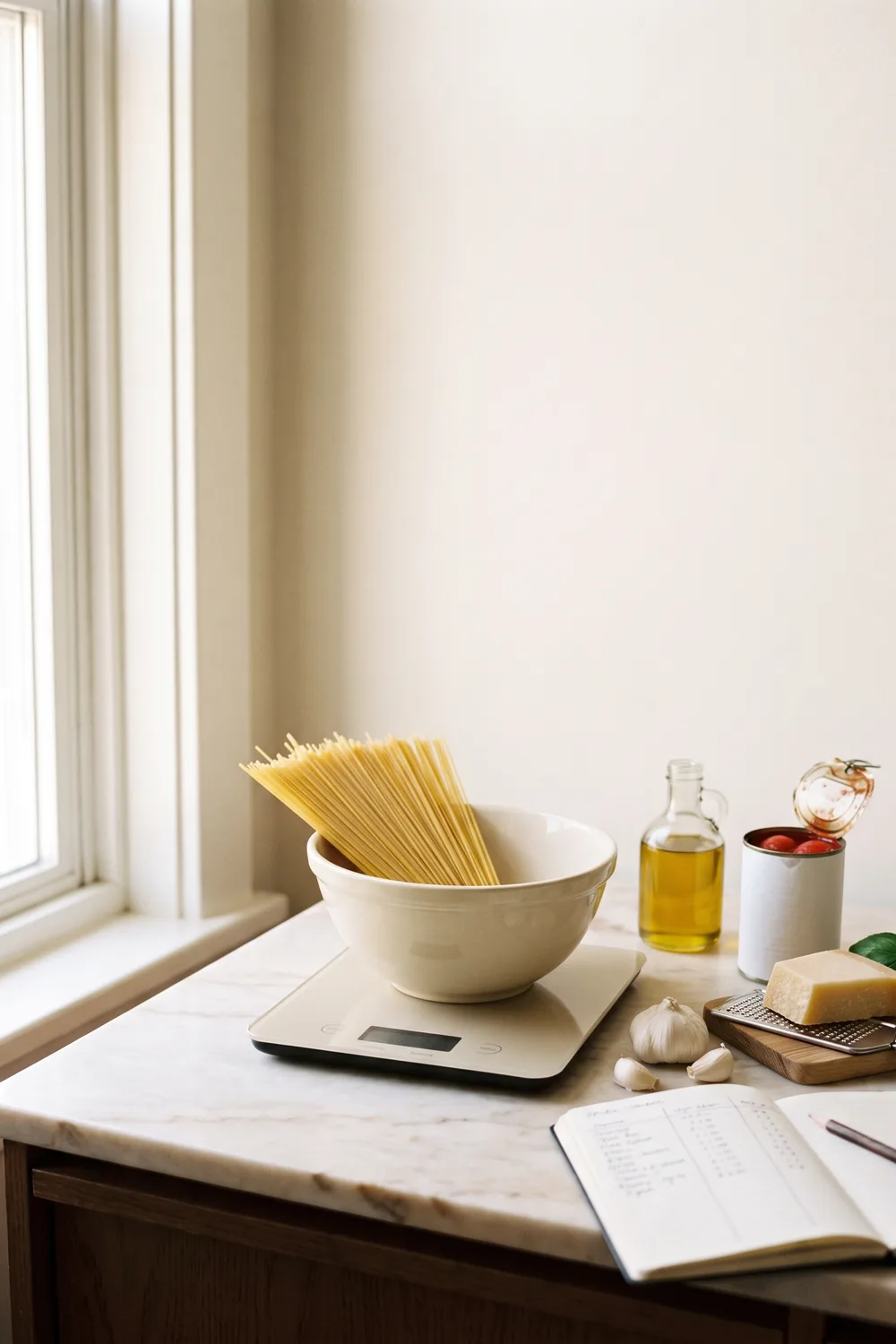
A worked example: chickpea and coconut curry for four
Here is a simple weeknight curry, calculated by hand. Calories per 100 grams come from the SR Legacy entries in USDA FoodData Central. Salt and dried spices are left out, because they add only a few calories.
| Ingredient | Amount | Calories per 100 g | Calories |
|---|---|---|---|
| Olive oil | 27 g (2 tbsp) | 884 | 239 |
| Onion, raw | 150 g | 40 | 60 |
| Chickpeas, canned, drained and rinsed | 480 g | 138 | 662 |
| Coconut milk, canned | 400 g | 197 | 788 |
| Crushed tomatoes, canned | 400 g | 32 | 128 |
| Spinach, raw | 100 g | 23 | 23 |
| Whole pot | 1,557 g | 1,900 |
Divided four ways, that's 475 calories a serving. Ladle the same pot into five bowls and each is 380, which is why the serving count matters as much as the scale.
Now look at where the calories sit. The oil and the coconut milk supply 1,027 of the 1,900 calories, about 54%, while 100 g of spinach adds 23. The reason is simple. According to the USDA's Food and Nutrition Information Center, carbohydrates provide 4 calories per gram, protein provides 4 and fat provides 9. Fats and oils are dense, so they're the ingredients worth weighing most carefully.
How do you work out calories per serving when portions are uneven?
Stews, soups and casseroles rarely split into equal portions. Who measures a ladle? The fix is to treat the finished dish as one ingredient and work out its calories per gram.
- Weigh the empty pot and write it down.
- Cook, then weigh the pot with the food in it.
- Subtract the pot. That's the cooked weight.
- Divide total calories by cooked weight for calories per gram.
- Weigh each portion and multiply.
Say the curry above cooks down to 1,400 g. That's 1,900 divided by 1,400, or about 1.36 calories per gram, so a 300 g bowl is about 410 calories and a 450 g bowl is about 610. The pot weighs less than the 1,557 g of raw ingredients because water evaporates as it simmers. Water carries no calories, so the total stays the same and each gram becomes more concentrated.
Should you weigh ingredients raw or cooked?
Weigh raw when you can, and always match the database entry to the state you weighed. In USDA FoodData Central, raw long-grain white rice has 365 calories per 100 g, while cooked long-grain white rice has 130. Log 150 g of cooked rice against the raw entry and you count 548 calories instead of 195.
Meat changes weight too. The USDA Agricultural Research Service publishes cooking yields for meat and poultry, which it describes as measures of changes in meat and poultry weights "resulting from moisture and fat losses during cooking." A chicken breast that goes into the pan at 200 g comes out lighter, so pair a raw weight with a raw entry and a cooked weight with a cooked one.
Why do two calorie counts for the same recipe differ?
Two cooks can make the same recipe and get different totals. Usually one of these is why:
| Mistake | What happens | Fix |
|---|---|---|
| Measuring oil and flour by volume | Small differences in dense ingredients add up | Weigh in grams |
| Raw weight, cooked entry, or the reverse | Rice is 365 vs 130 calories per 100 g | Match the entry to what you weighed |
| Forgetting the cooking fat | The oil in the pan is often one of the biggest numbers | Weigh it before it goes in |
| Counting food nobody ate | Marinade poured away, oil left in the pan | Leave out what stayed behind |
| Generic entries for branded foods | Brands vary | Use the label on your pack |
| Trusting the printed serving count | "Serves 4" is the author's guess | Divide by the portions you actually serve |
The last one matters most. For packaged food, the FDA's guide to the Nutrition Facts label notes that a serving size "is not a recommendation of how much you should eat or drink." A recipe's yield is the same kind of number: if three people finish a "serves 4" pot, it serves three.
How does Plate estimate calories in a recipe?
Plate runs the same sum, ingredient by ingredient. Every recipe shows estimated calories for the whole recipe and per serving, the calorie contribution of each ingredient, and optional protein, carbs, fat and fiber estimates. Edit an amount and the numbers recalculate. Allergen warnings and dietary tags appear on every recipe, and full ingredient-level nutrition is part of Plate Pro.
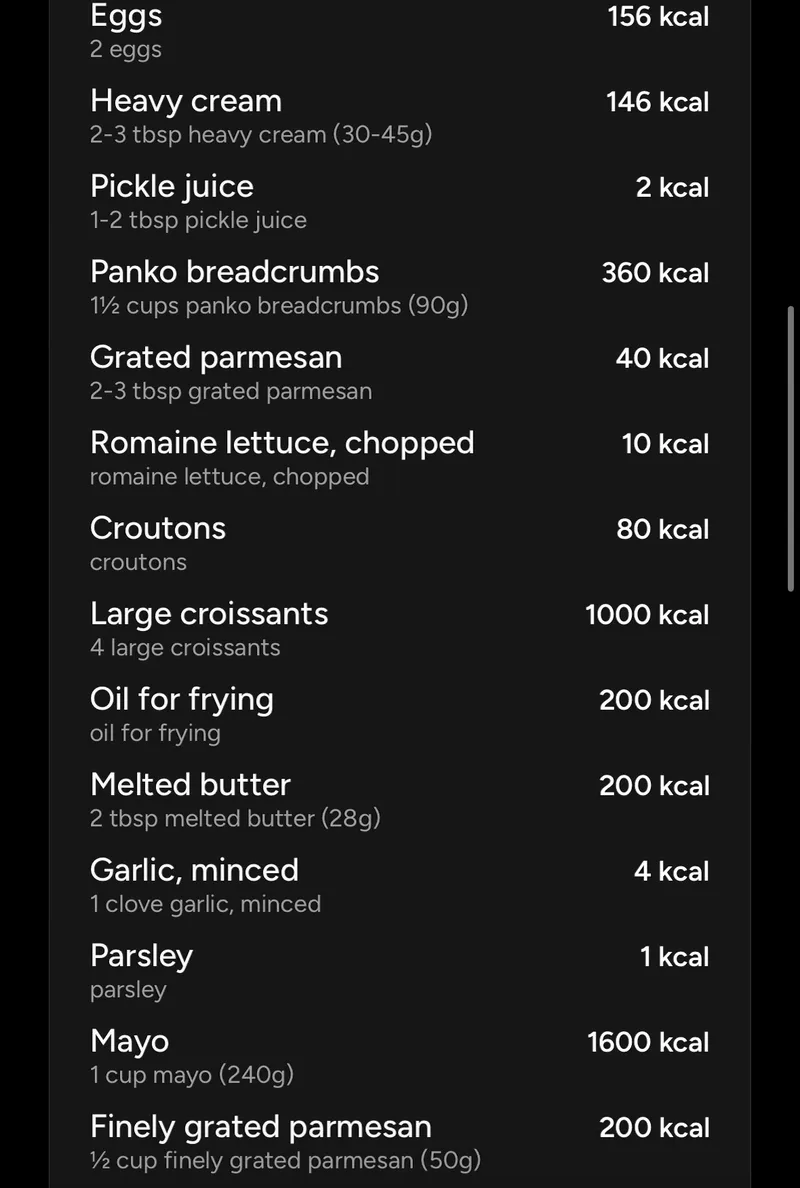
A single total tells you a dish is rich; the breakdown tells you why. Above, one cup of mayo (240 g) is estimated at 1,600 calories, more than four large croissants at 1,000. Want a lighter version? You know which line to change.
You can sanity-check any per-serving number with the 4-4-9 rule. The chocolate chip cookie recipe below shows 200 calories a serving, with 4 g of protein, 28 g of carbohydrate and 9 g of fat. Multiply out 4 x 4, plus 28 x 4, plus 9 x 9, and you get 209 calories, close to the 200 shown. Small gaps are normal, because each figure is rounded.
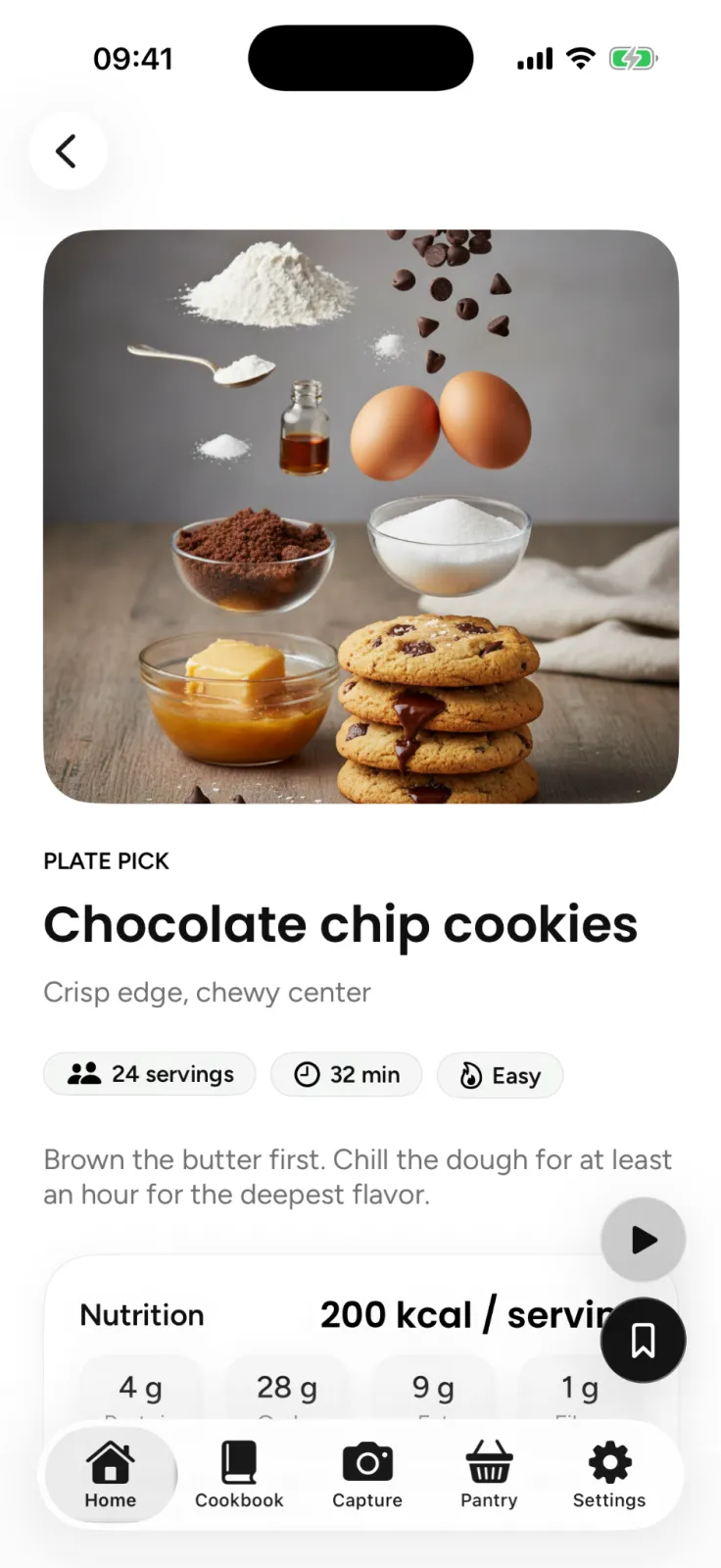
Plate's figures are AI estimates generated from the ingredient list. They vary by brand and preparation, and they aren't medical or dietary advice. Plate isn't a calorie tracker either: no daily budgets, weight goals or scores.
What if the recipe came from a photo or a video?
Then the amounts are estimates too, and the calories inherit that uncertainty. Our photo to recipe guide explains what a camera can't see, like the butter in a sauce, and video to recipe covers checking amounts copied from a video. Changing the yield is simpler: scaling a recipe up or down changes the total but not the calories per serving. And if you cook the same ten dishes most weeks, keep them in one cookbook and run the numbers once.
FAQ
Do you count calories in a recipe raw or cooked?
Count from raw weights with raw database entries when you can, or use a cooked entry for food you weighed cooked. Never mix them: USDA FoodData Central lists raw white rice at 365 calories per 100 g and cooked at 130.
How do I find calories per serving if portions are uneven?
Weigh the finished dish, divide the total calories by its cooked weight to get calories per gram, then multiply by the weight of each portion. It works well for soups, stews and casseroles.
Does doubling a recipe change the calories per serving?
No, as long as each portion stays the same size. The total doubles and so does the number of servings, so each serving is unchanged.
Is there an app that calculates calories in a recipe?
Yes. Plate estimates calories for the whole recipe, per serving and per ingredient, and recalculates when you edit an amount. It's free to start, with full ingredient nutrition in Plate Pro. Treat the numbers as estimates.
Get started
Weigh one weekly recipe once and you'll know its numbers for good. Or let an app do the arithmetic: Plate is free to start on the App Store, the Plate page shows everything it does, and there are more guides in the Plate category.