PlateRecipes8 min read
How to scale a recipe up or down without ruining it
How to scale a recipe up or down: find the conversion factor, multiply every ingredient, halve eggs by weight, then adjust pan size, seasoning and cooking time.
To scale a recipe, divide the number of servings you want by the number the recipe makes. That's your conversion factor. Multiply every ingredient by it, round awkward amounts like half an egg sensibly, then check what doesn't scale in a straight line: pan size, seasoning, evaporation and cooking time.
We make Plate, an AI recipe keeper for iPhone that rescales servings in Cook Mode, so we've thought a lot about what a multiplier can and can't do. This guide covers the math, a ready-made factor table, the egg problem, pans and timing, and how to handle a bigger batch safely.
How do you scale a recipe up or down?
Scaling a recipe means changing how much it makes while keeping the proportions the same. The tool is a conversion factor: the yield you want divided by the yield the recipe gives. A recipe for 4 that you want to serve 6 has a factor of 1.5, and cutting it to 2 servings gives 0.5. Multiply every ingredient by the factor, ideally in grams, because weights scale cleanly while cups and spoons turn into awkward fractions. Round where it makes sense: 5.5 potatoes can be 5 large ones or 6 small. Then adjust the parts of cooking that aren't proportional. A bigger batch may need a bigger pan, and the pan changes how fast liquid reduces and how long food takes to cook through. Add salt and strong spices gradually and taste as you go. Finally, judge doneness by temperature and texture rather than by the original timer.
How do you find the conversion factor?
Divide the servings you want by the servings the recipe makes. That's the whole formula. Culinary Math, an open textbook by Eunice Graham of Renton Technical College, uses cookies as the example: a recipe that yields 48 cookies, scaled to 60, has a conversion factor of 1.25, so you "take every ingredient amount and multiply it by 1.25."
Here are the factors you'll use most, applied to 200 g of flour:
| Recipe makes | You want | Conversion factor | 200 g of flour becomes |
|---|---|---|---|
| 4 servings | 2 | 0.5 | 100 g |
| 6 servings | 4 | 0.67 | 133 g |
| 8 servings | 10 | 1.25 | 250 g |
| 4 servings | 6 | 1.5 | 300 g |
| 4 servings | 8 | 2 | 400 g |
| 2 servings | 6 | 3 | 600 g |
A factor below 1 shrinks the recipe; above 1 grows it. If the recipe lists cups and spoons, convert the big ingredients to grams first. Two-thirds of a cup is easy to get wrong; 133 g isn't.
How do you halve a recipe with 3 eggs?
Crack all three into a bowl, beat them, and use half by weight. A kitchen scale makes this exact, and a tablespoon measure gets you close. The leftover beaten egg goes into tomorrow's breakfast or an egg wash; refrigerate it like any other perishable food.
Egg size matters when you scale, too. The USDA's Agricultural Marketing Service sizes eggs by the minimum weight of a dozen in its United States Standards, Grades, and Weight Classes for Shell Eggs:
- Jumbo: at least 30 ounces per dozen
- Extra large: at least 27 ounces per dozen
- Large: at least 24 ounces per dozen, about 2 ounces an egg
- Medium: at least 21 ounces per dozen, about 1.75 ounces an egg
Those are minimums for a whole dozen in the shell, so single eggs vary. The practical point: three large eggs weigh at least 6 ounces between them, which is closer to three and a half medium eggs than to three. When the egg count gets awkward, think in weight.
Which parts of a recipe don't scale in a straight line?
Ingredients mostly scale with the factor. Cooking conditions often don't. Watch these:
- Salt and strong spices. Add the scaled amount gradually and taste before adding the rest. It's easy to add more and impossible to take it out.
- Liquids that reduce. Evaporation happens at the surface. A doubled sauce in the same pan has more depth and the same surface, so it reduces more slowly. A wider pan speeds it up.
- Cooking time. A deeper layer takes longer to heat through, and a halved recipe in the original dish finishes sooner. Start checking early.
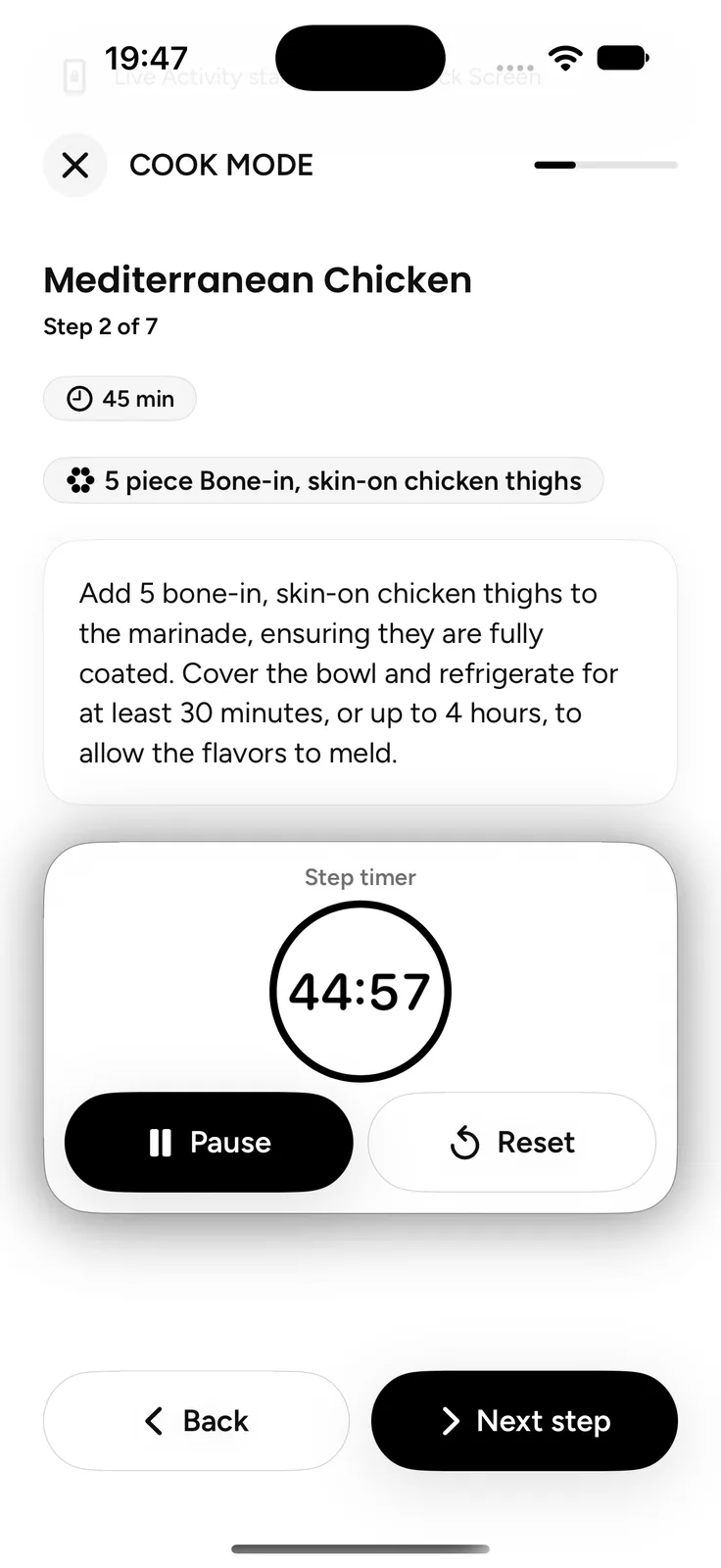
- Waiting times. Marinating, resting, rising and chilling don't change with batch size. Ten chicken thighs need as long in the marinade as five.
- Equipment. A pot that's too full won't simmer evenly, and mixers and food processors have a limit. Two batches can beat one oversized one.
- Baking. It's the least forgiving. Weigh everything, including baking powder and soda, and for big jumps consider baking two batches instead of one.
How do you change pan size when you double a recipe?
Compare pan areas, not pan names. A doubled recipe needs roughly twice the area to bake at the same depth:
| Pan | Approximate area |
|---|---|
| 8-inch round | 50 square inches |
| 8-inch square | 64 square inches |
| 9-inch round | 64 square inches |
| 10-inch round | 79 square inches |
| 9-inch square | 81 square inches |
| 9 x 13-inch rectangle | 117 square inches |
Two things fall out of the arithmetic. First, a 9-inch round and an 8-inch square hold almost exactly the same area, so they're interchangeable for the same recipe. Second, a doubled 8-inch square recipe needs about 128 square inches, and a 9 x 13 pan is the closest common size. The batter will sit slightly deeper, so it may need a few more minutes. Halving a 9 x 13 recipe goes the other way: an 8-inch square gives a slightly thinner layer that will finish sooner.
Because times shift, check doneness by temperature. The CDC says "the only way to tell if food is safely cooked is to use a food thermometer," and lists 165°F for all poultry, 160°F for ground meats such as beef and pork, 165°F for leftovers and casseroles, and 145°F for whole cuts of beef, veal, lamb and pork, followed by a 3-minute rest.
How do you cool and store a bigger batch safely?
A doubled recipe often means leftovers, and big pots of food cool slowly. The CDC's guidance is straightforward:
- Refrigerate perishable food, including cooked leftovers, within 2 hours, or within 1 hour if it's been above 90°F.
- Package warm or hot food into several clean, shallow containers, then refrigerate. Small portions chill faster.
- Remember why: bacteria can multiply rapidly in the "Danger Zone" between 40°F and 140°F.
How does Plate scale servings?
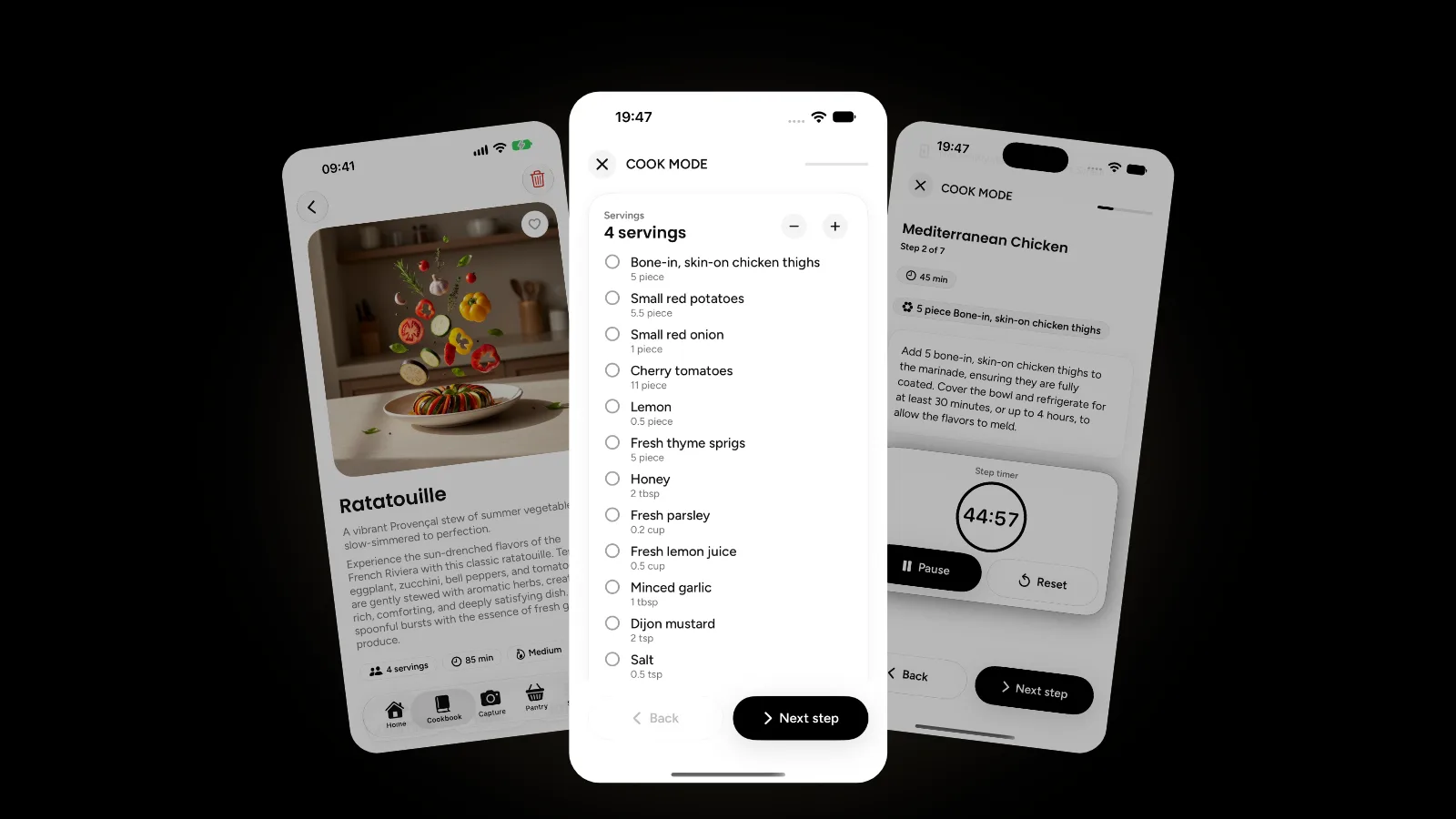
In Plate, Cook Mode opens with a servings card above the ingredient checklist. Tap plus or minus and every ingredient amount recalculates for the new number of servings. From there, Cook Mode walks you through one step at a time with built-in timers, a tickable checklist and a Live Activity that keeps your timer on the Lock Screen.
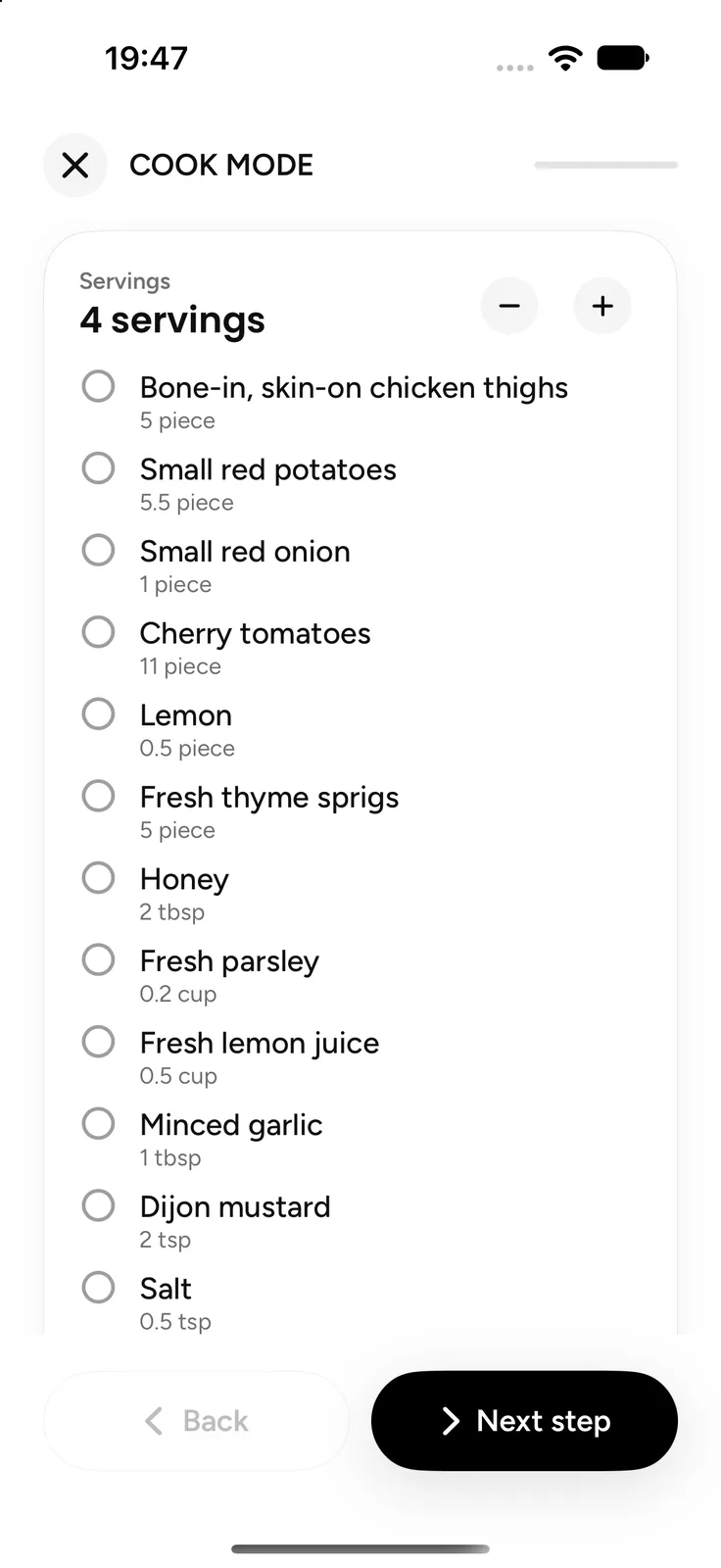
The app does the multiplication; you still make the judgment calls above. When a scaled amount lands on 5.5 potatoes or 0.2 cup of parsley, round to what you have. When the batch doubles, think about the pan.
Scaling changes a recipe's total nutrition but not the nutrition per serving, as long as each portion stays the same size. Our guide to calculating calories in a recipe explains why. Plate's nutrition figures are estimates to help you cook, not medical or dietary advice.
When should you scale instead of finding a new recipe?
Scale when you trust the recipe and only the quantity is wrong: dinner for two from a family-size recipe, or a party-size batch of a weeknight favorite. That's why it pays to keep the recipes you cook most in one cookbook, where the yield is always written down. And if you're scaling down because you only have half the ingredients, try cooking with what you have instead. A recipe copied from a cooking video often doesn't state servings at all, so set them first; our guide to video to recipe covers that check. More guides are in the Plate category.
FAQ
Can you scale any recipe?
Most savory recipes scale well with a conversion factor. Baking is less forgiving, so weigh every ingredient and, for big changes, bake two batches. Seasoning, evaporation, pan size and cooking time always need a second look.
How do I halve a recipe that calls for one egg?
Beat the egg and use half of it, by weight on a kitchen scale or with a tablespoon. USDA standards put a dozen large eggs at a minimum of 24 ounces, about 2 ounces an egg in the shell.
Do you double the cooking time when you double a recipe?
No. Cooking time depends on the depth of the food and the pan, not the quantity. A deeper dish takes somewhat longer, so start checking at the original time and use a thermometer to confirm doneness.
Does scaling a recipe change the calories per serving?
No, as long as each portion stays the same size. Doubling a recipe doubles the total calories and the number of servings, so each serving is unchanged.
Get started
Pick a recipe you love that never makes the right amount, and scale it once with a pencil and the factor table above. Or let the app do the math: Plate is free to start on the App Store, and the Plate page shows what else it can do.