PlateCooking tips9 min read
How much food per person: a portion guide for hosts
How much food per person: meat, fish, pasta, rice, sides and dessert in grams and US units, why the charts disagree, and a worked menu for 12 guests.

For a main course, plan about 170-225 g (6-8 oz) of boneless meat per adult, or 450-565 g (1-1¼ lb) of whole turkey. Add 75-100 g (2.6-3.5 oz) of dry pasta or about 75 g of dry rice when it's the main dish, two to four sides and one dessert. Count children as half and add 10-15% for a buffet.
We make Plate, a recipe keeper for iPhone whose Cook Mode rescales servings, so we care about the step before scaling: knowing how many servings you need. This guide compares the published figures, explains why they disagree, and works one menu for 12 guests.
How much food per person should you plan?
How much food per person depends on three things: who is eating, how many dishes share the table, and whether guests serve themselves. The published planners agree on a rough shape. The Old Farmer's Almanac party planner, dated May 2026, suggests 170-225 g (6-8 oz) of beef, pork or ham per person, two to four side dishes and one slice of cake or pie. For starches, the UK's Love Food Hate Waste portion calculator gives 75 g (2.6 oz) of dry rice or pasta per person when it's the main part of the meal, and about 37 g (1.3 oz) as a side. Children typically eat about half an adult portion, the Almanac says, and self-serve buffets need 10-15% more. These are averages for ordinary adult appetites: a starting point to adjust for your guests and menu, not a rule to follow to the gram.
The method takes three steps:
- Count portions, not people. Adults and teenagers count as 1, young children as 0.5.
- Pick the menu shape. One main and a starch, a main with three or four sides, or a buffet. More dishes means smaller portions of each.
- Multiply. Portions times the per-person amount is what you buy and cook.
Why do portion charts disagree?
The numbers can differ by a factor of two, for three reasons. The meal: Love Food Hate Waste halves its starch figure when it's a side. The purpose: healthy-eating guides describe an everyday plate, while party planners allow for seconds, so the World Cancer Research Fund puts cooked meat at 90 g and the Almanac allows 225 g (½ lb) of cooked beef. The weight: some figures are raw or dry, others cooked. Check before you multiply.
How much meat, fish or tofu per person?
The Almanac's chart shows a useful pattern: bone-in cuts need about one and a half times the boneless weight. Here are its party figures next to everyday portions from the World Cancer Research Fund's 2026 What is a healthy portion size? poster and the British Nutrition Foundation's Find your balance guide:
| Protein, per adult | Boneless | Bone-in or whole | Source |
|---|---|---|---|
| Pork or lamb, roast or chops | 225 g (½ lb) | 340 g (¾ lb) | Almanac |
| Chicken thighs | 150 g (⅓ lb) | 225 g (½ lb) | Almanac |
| Whole turkey | - | 450-565 g (1-1¼ lb), raw | Almanac |
| Fish fillet | 225 g (½ lb) | - | Almanac |
| Cooked meat, everyday | 90 g (3.2 oz) | - | WCRF |
| Cooked fish, everyday | 140 g (4.9 oz) | - | WCRF |
| Tofu or meat alternatives | 80-100 g (2.8-3.5 oz) | - | WCRF |
| Cooked beans or lentils | 120 g (4.2 oz) | - | BNF |
The Almanac lists turkey at raw weight. The everyday rows are cooked portions for an average adult, and the British Dietetic Association's portion sizes fact sheet gives the same figures: 90 g of cooked meat or 140 g of fish. The Almanac doesn't list tofu, so if tofu is the main, start at the top of its range.
How much pasta, rice and potatoes per person?
For a main, plan 75-100 g (2.6-3.5 oz) of dry pasta and about 75 g (2.6 oz) of dry rice per adult; as a side, roughly halve it. Most sources land there, but not all:
| Source | Dry pasta per person | Dry rice per person | Context |
|---|---|---|---|
| Love Food Hate Waste (UK) | 75 g (2.6 oz) main, 37 g (1.3 oz) side | Same as pasta | Food-waste planner |
| Love Food Hate Waste (NZ) | 100 g (3.5 oz) | ⅓ cup | Per person |
| Barilla (US) | 57 g (2 oz) | - | Rule of thumb |
| Old Farmer's Almanac | 113 g (4 oz) | - | Party planner |
| World Cancer Research Fund | 75 g (2.6 oz) | 75 g (2.6 oz) | Healthy portion |
The two US figures differ by a factor of two, because a brand's rule of thumb and a party chart answer different questions. We'd start at 75 g and move toward 100 g when pasta is the whole meal.
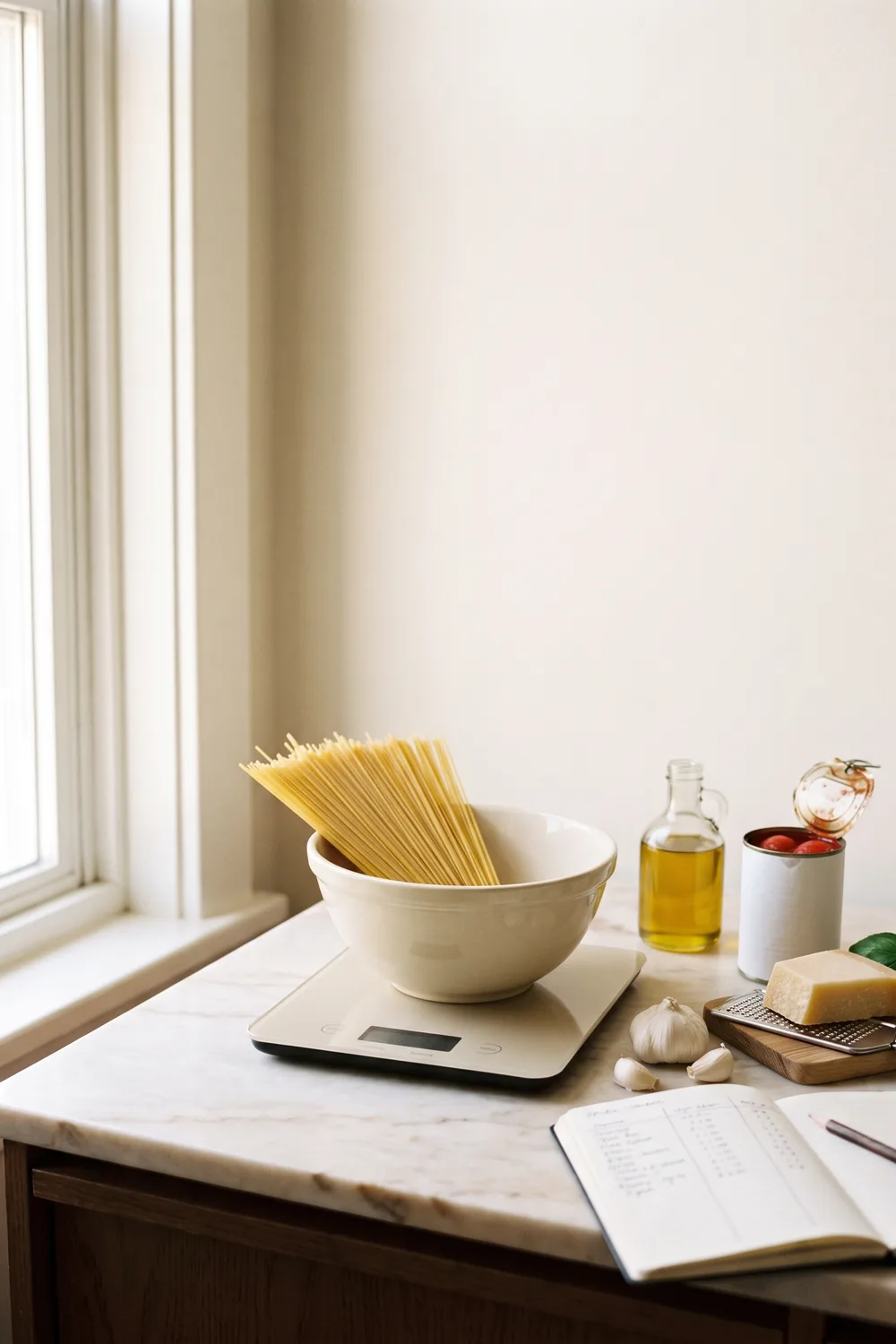
Weigh them dry, since both gain weight as they cook. No scale? Barilla says 2 oz of dry spaghetti cooks to about 1 cup, and Love Food Hate Waste NZ suggests ⅓ cup of rice per person. For potatoes, the British Dietetic Association puts an adult portion at 175-180 g (6.2-6.3 oz), boiled or baked, and the Almanac at 150-225 g (⅓-½ lb).
How many sides, salads and desserts per guest?
Plan two to four sides, the Almanac says, mixing vegetables, a starch and a salad. Per person, it gives 115-150 g (¼-⅓ lb) of mixed vegetables and two bread rolls, and about one head of lettuce for every five guests. With four sides, we'd plan the bottom of each range.
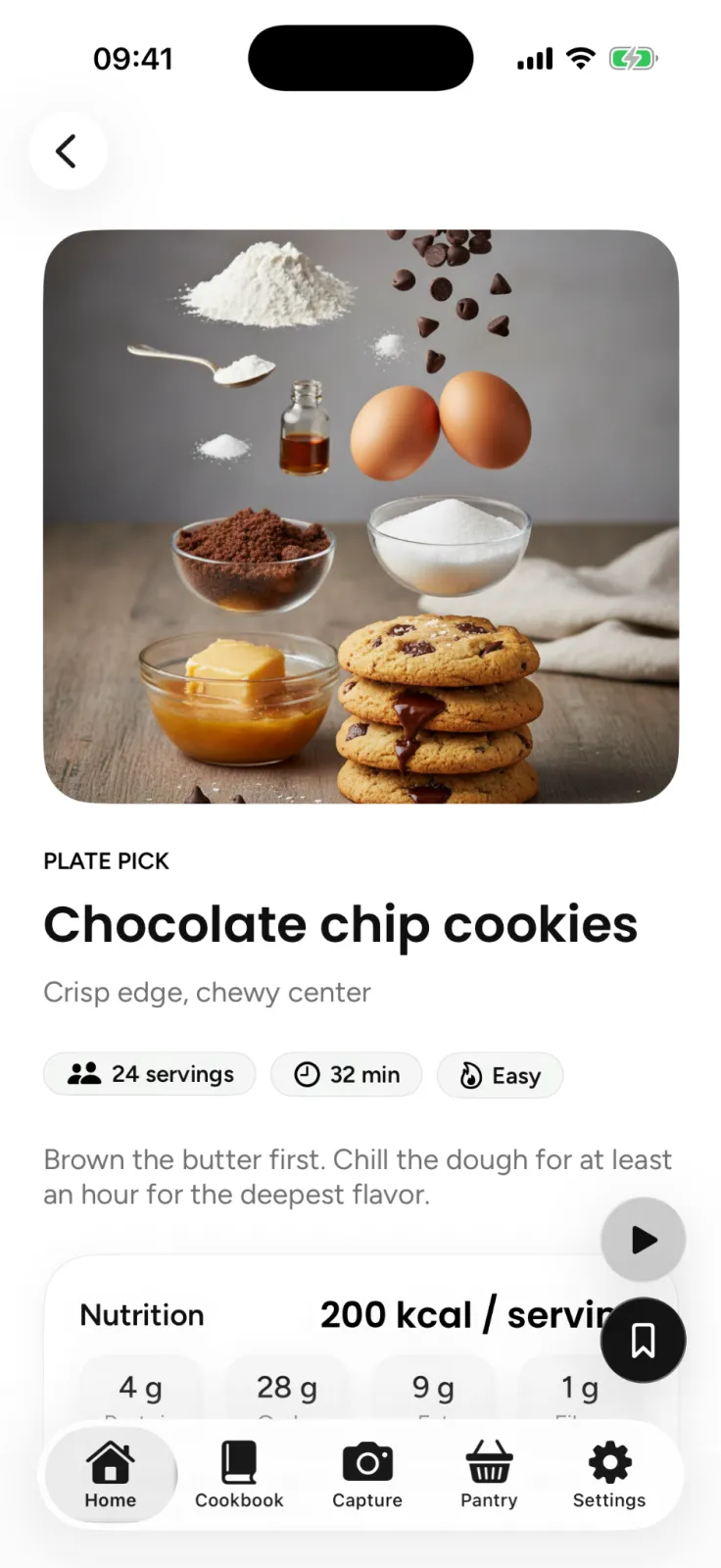
For dessert, plan one slice of cake or pie per guest, a little less each if there's more than one dessert. For cookies and bars, the recipe's yield does the counting.
How do you adjust for kids, big appetites and buffets?
Start from your portion count, then adjust for who's coming:
- Young children: about half an adult portion, the Almanac says, and very young children less.
- Teenagers: the Almanac counts children as half a serving unless they're older, so we count teenagers as adults.
- Big appetites: plan the top of each range.
- Buffets: guests take more of what they like, so the Almanac adds 10-15%.
- Planned leftovers: the USDA's Leftovers and Food Safety guidance says to refrigerate them in shallow containers within 2 hours of cooking (1 hour above 32 °C, or 90 °F) and use them within 3 to 4 days. See cooking with what you have for ideas.
Worked example: how much food for 12 guests?
Twelve guests: nine adults, one teenager and two children aged 6 and 8. That's 10 full portions plus two halves, so 11 portions. The menu is bone-in chicken thighs, rice, roasted vegetables, a green salad and a cake.
| Dish | Per portion | Total | Buy or cook |
|---|---|---|---|
| Chicken thighs, bone-in | 225 g (½ lb) | 2,475 g | 2.5 kg (5.5 lb) |
| Rice, dry | 50 g (1.8 oz) | 550 g | 550 g (1.2 lb) |
| Mixed vegetables | 115-150 g (¼-⅓ lb) | 1,265-1,650 g | 1.5 kg (3.3 lb) |
| Lettuce | 1 head per 5 guests | 2.4 heads | 2-3 heads |
| Cake | 1 slice per guest | 12 slices | 1-2 cakes |
Rice is the only starch, so we used 50 g, between Love Food Hate Waste's side and main figures. Dessert counts per guest: nobody wants half a slice. Boneless thighs would be 1.65 kg (3.6 lb). As a buffet, add 10-15%: about 2.7-2.85 kg (6-6.3 lb) of chicken.
How do you turn per-person amounts into a recipe?
Your portion count becomes the recipe's servings number. If your rice recipe serves 4 and you need 11 portions, multiply every ingredient by 11 ÷ 4 = 2.75. Our guide to scaling a recipe up or down covers rounding and what doesn't scale, like pan size.
Check what the recipe calls a serving first. A pasta recipe for 4 that uses 500 g of pasta gives 125 g each, above every figure in the table. At 75 g a head, it feeds six or seven.
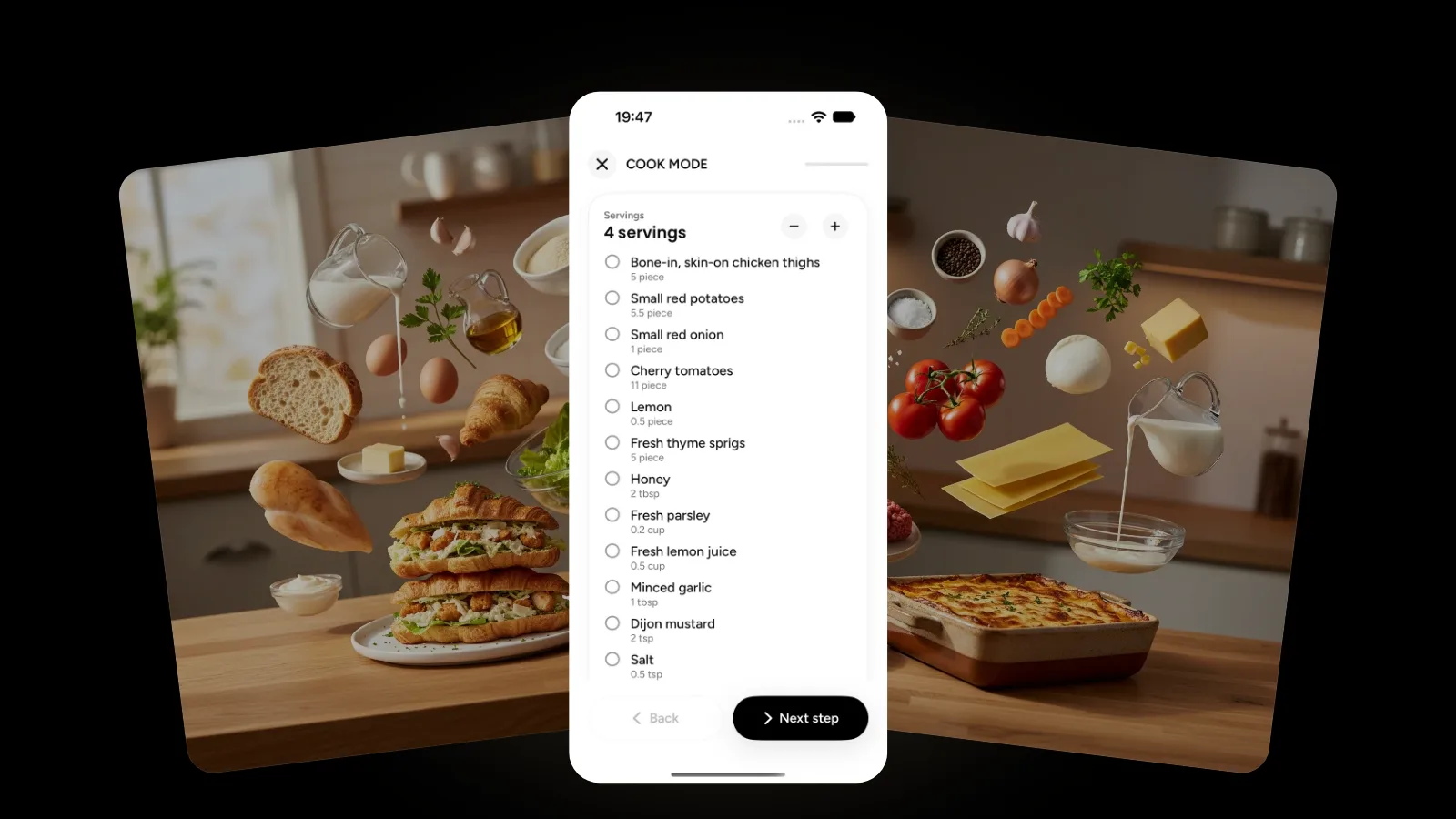
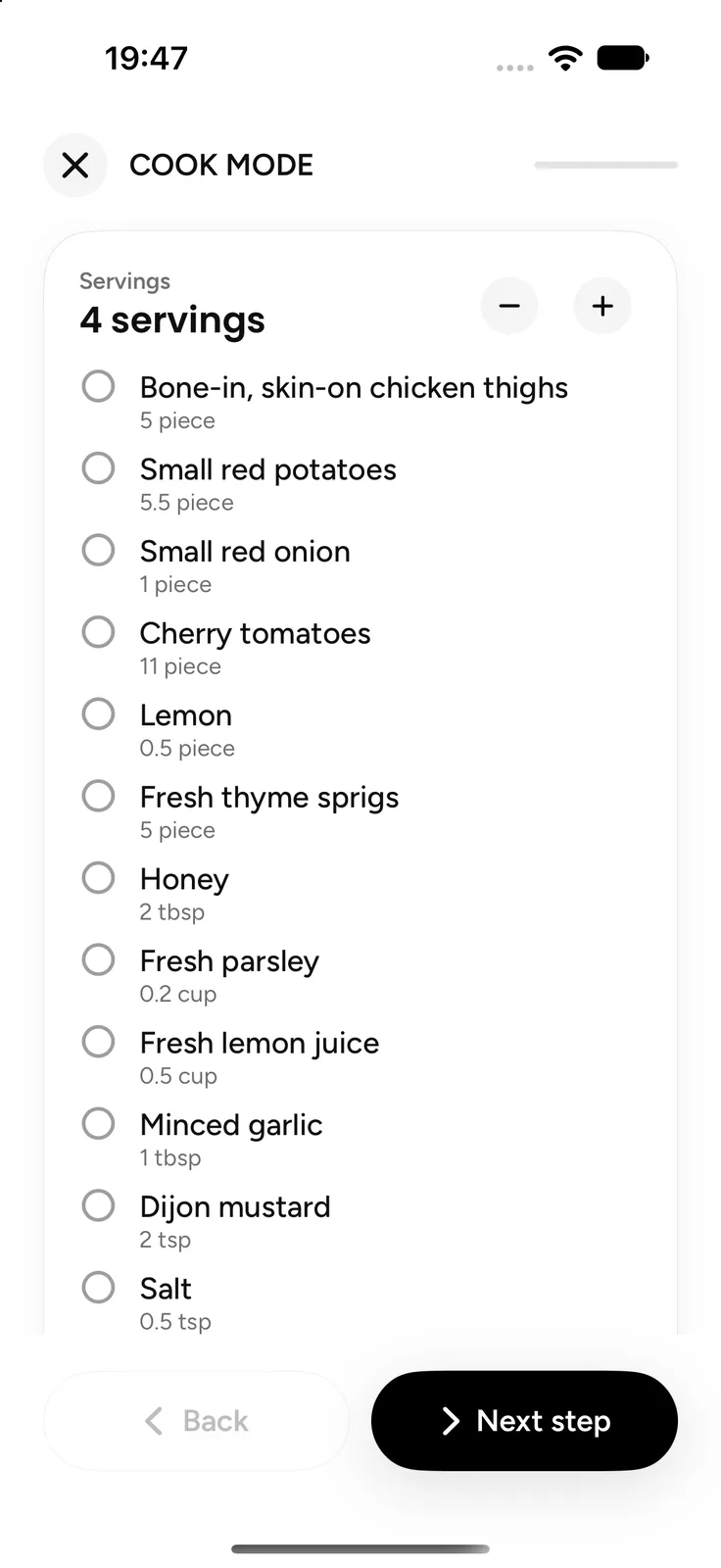
In Plate, Cook Mode opens with a servings card above a tickable ingredient checklist. Tap plus or minus to reach your portion count, and every amount recalculates. Plate doesn't count guests or plan menus; it does the multiplication.
Scaling changes totals, not each serving, as our guide to calculating calories in a recipe explains. A bigger batch means more chopping, so plan your mise en place. More guides are in the Plate category.
FAQ
How much food do I need for 20 guests?
For 20 adults, plan 3.4-4.5 kg (7.5-10 lb) of boneless beef or pork, or 1.5 kg (3.3 lb) of dry pasta if pasta is the main at 75 g each. Add two to four sides and 20 desserts. Count children as half, and add 10-15% for a buffet.
How much rice per person should I cook?
About 75 g (2.6 oz) of dry rice per adult as the main starch, according to Love Food Hate Waste UK and the World Cancer Research Fund, and about 37 g (1.3 oz) as a side. Without a scale, Love Food Hate Waste NZ suggests ⅓ cup per person.
How much meat per person for a party?
The Old Farmer's Almanac suggests 170-225 g (6-8 oz) of beef, pork or ham per adult, or 450-565 g (1-1¼ lb) of whole turkey, raw weight. Bone-in cuts need about one and a half times the boneless amount: 340 g (¾ lb) of bone-in pork against 225 g boneless.
Should I measure portions raw or cooked?
Measure the way your chart does. The Almanac mixes both, listing turkey at raw weight and boneless beef cooked, while the World Cancer Research Fund uses cooked weight, like 90 g of cooked meat. Pasta and rice gain weight as they cook, so weigh them dry.
Get started
Count portions, pick a menu shape, multiply, then set each recipe's servings to match. Plate is free to start on the App Store, and the Plate page shows what else it can do.