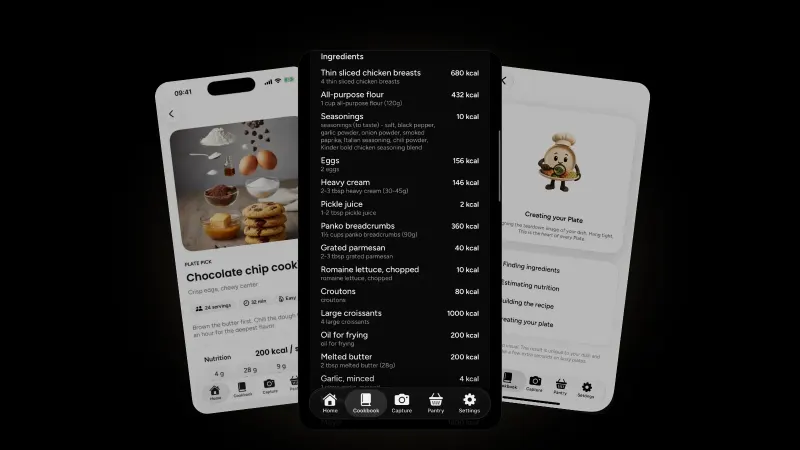
PlateNutrition9 min read
How to read a nutrition label: serving size, %DV and more
How to read a nutrition label in five steps: serving size, calories, %DV and the 5/20 rule, plus EU per 100 g, UK traffic lights and Nutri-Score.
To read a nutrition label, check the serving size and servings per container first, then the calories in one serving. Use the % Daily Value to judge each nutrient: the FDA calls 5% DV or less low and 20% DV or more high. Then scan the nutrients to limit, the ones to get more of, and the ingredient list.
We make Plate, a private AI cookbook for iPhone that shows estimated calories, macros and allergen tags on every recipe. This guide gives a five-step reading order for the US Nutrition Facts panel, a tour of label systems from Europe to Japan, and what to do when the food is your own cooking.
This is general information, not medical or dietary advice. For a health condition, follow your doctor or a registered dietitian.
How do you read a nutrition label?
Reading a nutrition label means working through the panel in a fixed order, so the numbers make sense together. The FDA's guide, How to Understand and Use the Nutrition Facts Label, goes the same way: serving information, calories, nutrients, then the percent Daily Value. Start with the serving size, because every number below it describes one serving, not the whole pack. Next, read the calories for that serving and multiply if you'll eat more. Then use the %DV column as a quick scale: the FDA says 5% DV or less of a nutrient per serving is considered low, and 20% DV or more is considered high. Look for less saturated fat, sodium and added sugars, and more dietary fiber, vitamin D, calcium, iron and potassium. Finish below the panel with the ingredient list, which runs from the heaviest ingredient to the lightest and is where allergens are declared.
In short, five steps:
- Serving size. Note the serving and how many servings the pack holds.
- Calories. Multiply by the servings you'll actually eat.
- %DV. 5% or less is low, 20% or more is high.
- Nutrients. Less saturated fat, sodium and added sugars; more fiber, vitamin D and minerals.
- Ingredients. Heaviest first, with allergens declared.
What does serving size tell you, and how is it different from a portion?
The serving size is the amount every other number on the panel describes. The FDA says it "reflects the amount that people typically eat or drink" and "is not a recommendation of how much you should eat or drink."
A portion is what you actually eat. The NIH's NIDDK defines it as "how much food you choose to eat at one time." If the label says one cup and your bowl holds two, you're eating two servings, and in the FDA's own example that means two times the calories and nutrients shown. Some packs carry a "dual column" label, per serving and per package. Cooking for a group? Our portion guide for hosts covers how much to make per person.
What does percent daily value mean?
The % Daily Value shows how much of a day's reference amount of a nutrient one serving provides. The FDA defines it as "the percentage of the Daily Value for each nutrient in a serving of the food," using 2,000 calories a day as a general guide. Your own needs may be higher or lower.
So is 15% good or bad? It depends on the nutrient: you want a high number for fiber and a low one for sodium. Here's what the 5/20 rule means in real amounts, using the FDA's Daily Values:
| Nutrient | Daily Value | 5% DV (low) | 20% DV (high) | Aim for |
|---|---|---|---|---|
| Saturated fat | 20 g | 1 g | 4 g | Less |
| Sodium | 2,300 mg | 115 mg | 460 mg | Less |
| Added sugars | 50 g | 2.5 g | 10 g | Less |
| Dietary fiber | 28 g | 1.4 g | 5.6 g | More |
Trans fat and total sugars don't list a %DV, and protein shows one only in specific cases.
Which nutrients should you look at first?
Start with the eight the FDA names: less saturated fat, sodium and added sugars, and more dietary fiber, vitamin D, calcium, iron and potassium. Of those, added sugars deserve a second look. The FDA's added sugars page explains that total sugars include sugars naturally present in foods like milk and fruit, while added sugars are those "added during the processing of foods." That's why a fruit yogurt can list more total sugars than added sugars. For context, the WHO recommends keeping free sugars below 10% of daily energy intake and, for adults, salt below 5 grams a day (2 grams of sodium).
The ingredient list fills in what the numbers can't. The FDA says ingredients are "listed in descending order of predominance by weight," so the first few make up most of the product.

Allergens are declared there too. The FDA requires the nine major US allergens, peanuts and sesame among them, to be named in the ingredient list or in a "Contains" statement next to it. In the UK, government advice says the 14 allergens must be emphasised in the ingredients list, for example in bold. Our guide on how to cook for someone with food allergies goes further.
How do nutrition labels differ around the world?
Outside the US, the back panel usually works per 100 g, and many countries add a front-of-pack sign that does some of the judging:
| Where | Label | What it shows |
|---|---|---|
| US | Nutrition Facts panel | Amounts and %DV per serving |
| EU | Nutrition declaration | Energy, fat, saturates, carbohydrate, sugars, protein and salt per 100 g or 100 ml |
| UK | Traffic lights on the front | Red for high, amber for medium, green for low |
| France and others | Nutri-Score | Letters A to E, dark green to dark orange |
| Canada | "High in" symbol with a magnifying glass | High saturated fat, sugars or sodium |
| Mexico | Black octagon seals | Excess calories, sugars, saturated fat, trans fat or sodium |
| Japan | 栄養成分表示 | Energy, protein, fat, carbohydrate and salt equivalent |
EU. Under Regulation (EU) No 1169/2011, the European Commission says the nutrition declaration "must be expressed per 100g or per 100ml," and may also be given per portion. Front-of-pack labels are voluntary.
UK. Some supermarkets and manufacturers add traffic lights on the front. The NHS guide to food labels sets the colours per 100 g:
- Total fat: low at 3 g or less, high above 17.5 g
- Saturated fat: low at 1.5 g or less, high above 5 g
- Total sugars: low at 5 g or less, high above 22.5 g
- Salt: low at 0.3 g or less, high above 1.5 g
Nutri-Score. Santé publique France describes a five-colour scale from dark green to dark orange, lettered A to E and calculated per 100 g or 100 mL. It weighs fibre, protein, fruit, vegetables and pulses against energy, saturated fat, sugars, salt and non-nutritive sweeteners. France first used it in 2017.
Canada. Health Canada's front-of-package symbol is black and white and uses a magnifying glass to flag foods high in saturated fat, sugars or sodium. Prepackaged foods that meet or exceed set levels need it, and the deadline was January 1, 2026.
Mexico. NOM-051 seals read EXCESO followed by the nutrient, such as EXCESO AZÚCARES or EXCESO SODIO, with extra warnings for caffeine and sweeteners. They started on 1 October 2020, according to PROFECO.
Japan. The Consumer Affairs Agency requires 栄養成分表示 on packaged processed foods: energy (熱量), protein, fat, carbohydrate and sodium shown as salt equivalent (食塩相当量).
Dates are a separate system; see best before vs use by.
How do you compare two products with different labels?
Put both on the same basis first. For US labels, the FDA suggests using %DV to compare products with the same serving size. Across countries, per 100 g is the common ground.
- Convert to per 100 g. Divide the amount per serving by the serving weight in grams, then multiply by 100.
- Match the sugar line. UK traffic lights use total sugars, so compare them with the US Total Sugars line, not Added Sugars.
- Turn sodium into salt. Multiply by 2.5; the NHS pairs 1.5 g of salt with 0.6 g of sodium.
- Compare similar foods. Cereal against cereal, not cereal against yogurt.
Say a US cereal lists 360 mg of sodium and 10 g of total sugars in a 40 g serving. Per 100 g, that's 900 mg of sodium (about 2.25 g of salt) and 25 g of sugars. Both sit above the NHS lines for high, which means red on a traffic light label.
How do you get nutrition facts for food you cook yourself?
Homemade food has no label, so you build one: weigh each ingredient, add up the nutrients and divide by the servings you actually cut. Our guide to calculating calories in a recipe works through it with USDA data.
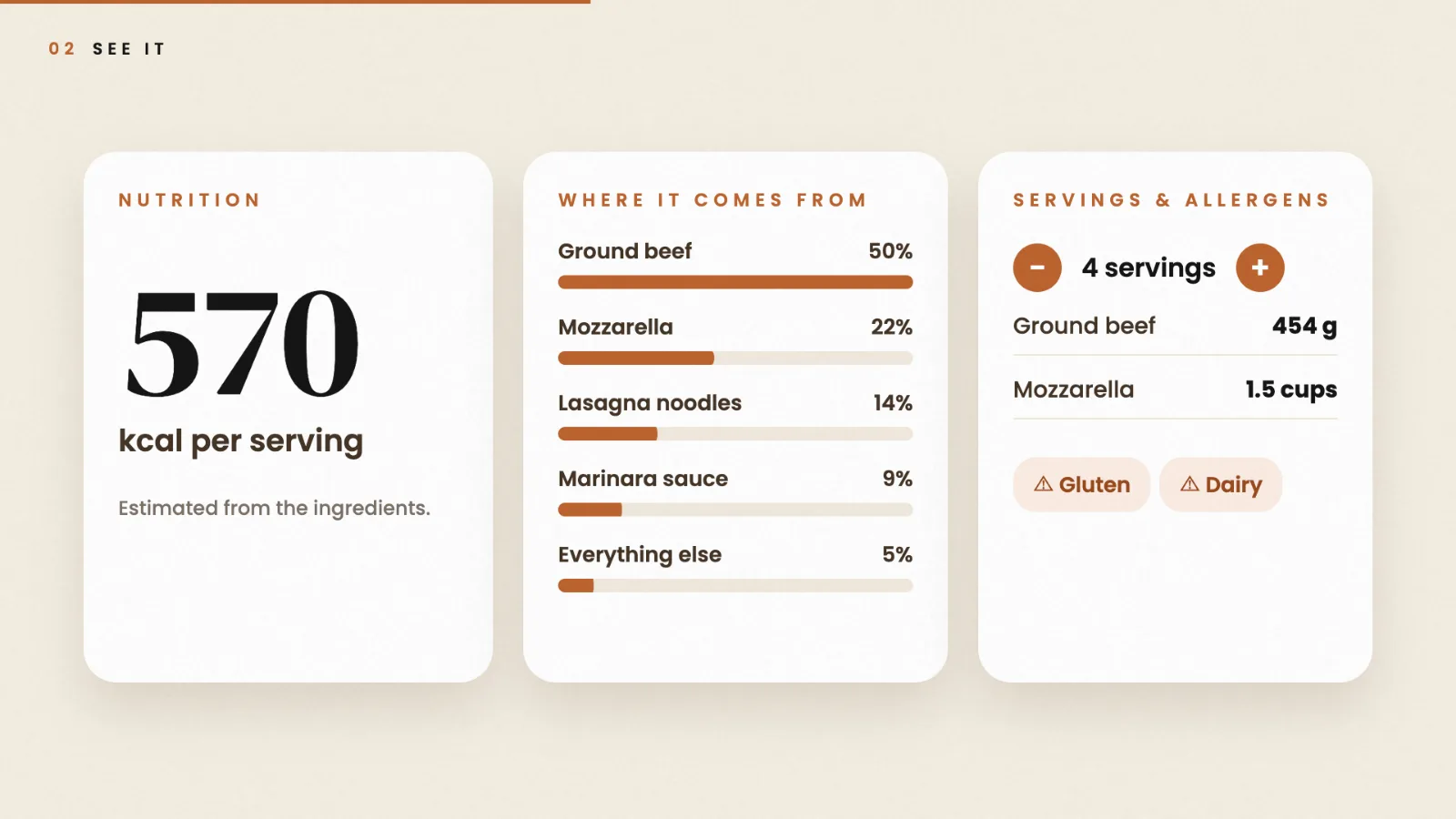
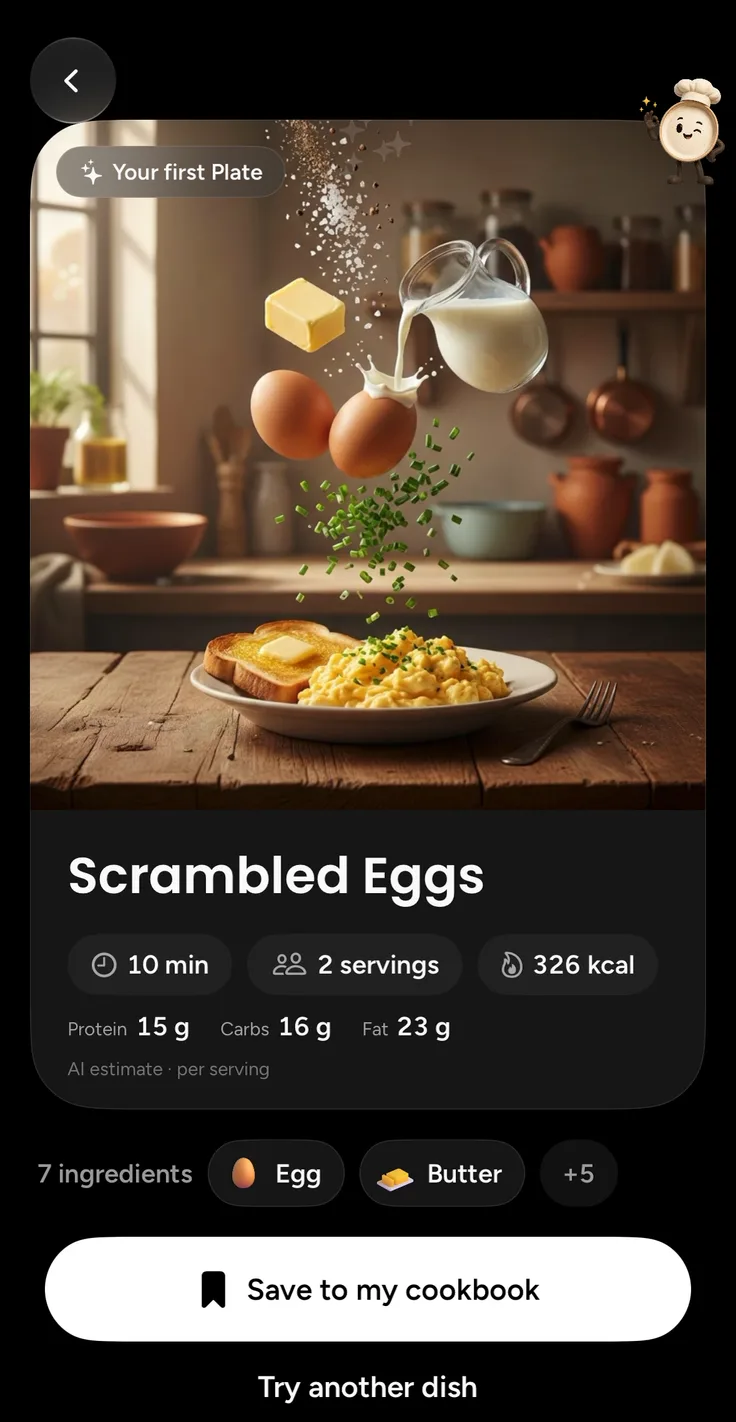
Plate does that sum for you. Every recipe shows estimated calories and macros for the whole recipe, per serving and per ingredient, with allergen and dietary tags; full nutrition is part of Plate Pro. These are AI estimates, not medical or dietary advice, and Plate isn't a calorie tracker, so there are no daily budgets or goals.
FAQ
What is a good %DV?
It depends on the nutrient. The FDA treats 5% DV or less per serving as low and 20% DV or more as high. Aim high for fiber and low for saturated fat, sodium and added sugars.
Is the serving size how much you should eat?
No. The FDA says the serving size "is not a recommendation of how much you should eat or drink." It reflects what people typically eat. Eat two servings and every number on the panel doubles.
What's the difference between total sugars and added sugars?
Total sugars include sugars naturally found in foods such as milk and fruit. Added sugars are those added during processing. Only added sugars carry a %DV, based on 50 g a day in a 2,000-calorie diet.
How do you convert sodium to salt?
Multiply sodium by 2.5: the WHO's 5 g salt limit equals 2 g of sodium. US labels list sodium, while EU, UK and Japanese labels list salt.
Get started
Try the five steps on one product you buy every week. For the food you cook, Plate is free to start on the App Store, the Plate page shows everything it does, and the Plate category has more kitchen guides.