
PlateCooking tips9 min read
Ingredient substitutions: what to use when you run out
Ingredient substitutions sorted by job: buttermilk, baking powder, eggs, cream, cornstarch and herbs, with university ratios and when not to swap.
A good substitute does the same job as the missing ingredient. For buttermilk, put 1 tablespoon of lemon juice or vinegar in a cup, fill it to 1 cup with milk and wait 5 minutes. Replace 1 teaspoon of baking powder with 1/4 teaspoon baking soda plus 5/8 teaspoon cream of tartar. Swap freely in sauces, carefully in baking.
We make Plate, a recipe keeper for iPhone with a pantry and allergen tags on every recipe. Every ratio below comes from university extension charts, grouped by the job each ingredient does, so you can work out swaps the charts don't list.
What can you use instead of a missing ingredient?
Use something that does the same job in about the same amount. Buttermilk: 1 tablespoon of lemon juice or vinegar topped up with milk to 1 cup and left 5 minutes, or 1 cup of plain yogurt. Baking powder: 1/4 teaspoon of baking soda plus 5/8 teaspoon of cream of tartar for each teaspoon. Cornstarch: 2 tablespoons of all-purpose flour for each tablespoon. Heavy cream: 3/4 cup of milk plus 1/3 cup of butter for each cup, in cooking and baking only, because it won't whip. Fresh herbs: 1 teaspoon of dried for each tablespoon of fresh. Kansas State University's Ingredient Substitutions chart names the catch: "Each ingredient has specific functions in a recipe, and a substitute may alter the flavor, color, texture, or volume, but still result in an acceptable product." Soups, stews and sauces forgive most swaps. Cakes, breads and home-canned food don't.
How do you choose an ingredient substitution by its job?
Ask what the missing ingredient does before you look for a replacement. Colorado State University Extension's Ingredient Substitutions guide starts in the same place: "Understand the physical and chemical properties of all ingredients." Most ingredients do one of seven jobs:
| Job | Typical ingredients | What the swap must copy |
|---|---|---|
| Acid | Buttermilk, yogurt, lemon juice, vinegar, cream of tartar | Sourness, and the acid baking soda reacts with |
| Leavening | Baking powder, baking soda, yeast | Gas, released at the right moment |
| Binding | Eggs, gelatin | Holding the crumb together as it sets |
| Fat | Butter, oil, cream | Richness, in solid or liquid form |
| Thickening | Flour, cornstarch, arrowroot, tapioca | Starch that sets a liquid |
| Sweetness | Sugar, honey, molasses, syrups | Sweetness, plus any liquid a syrup brings |
| Flavor | Herbs, spices, garlic, wine, sauces | Taste only |
The job tells you how strict to be. A flavor swap only changes the taste, while an acid or leavening swap changes the chemistry, so a missing teaspoon matters more in a muffin than in a stew.
What can replace buttermilk, cream, sour cream or milk?
Dairy gaps are the easiest to fill from what's already in the fridge. These ratios come from North Dakota State University's Ingredient Substitutions chart, which Purdue Extension publishes as HHS-784-W:
- Buttermilk, 1 cup: 1 cup minus 1 tablespoon of milk, plus 1 tablespoon of lemon juice or vinegar, left 5 to 10 minutes. Or 1 cup of plain yogurt.
- Heavy cream, 1 cup: 3/4 cup of milk plus 1/3 cup of butter, for cooking and baking. Colorado State says it "will not whip."
- Whipped cream: chill a 13-ounce can of evaporated milk for 12 hours, add 1 teaspoon of lemon juice and whip until stiff.
- Sour cream, 1 cup: 1 cup of plain yogurt. In cooking, NDSU adds a tablespoon of cornstarch per cup to prevent separating.
- Whole milk, 1 cup: 1/2 cup of evaporated milk plus 1/2 cup of water.

Why not plain milk? NC State University's explainer, The Difference Between Baking Soda and Baking Powder, names buttermilk, yogurt and vinegar as acids baking soda reacts with. Lemon juice adds that acid back.
What can replace baking powder, baking soda, eggs or flour?
Baking swaps leave the least room for error, so stick to exact ratios. One teaspoon of baking powder equals 1/4 teaspoon of baking soda plus 5/8 teaspoon of cream of tartar in the NDSU, K-State, University of Illinois Extension and Texas A&M AgriLife charts.
Baking soda is the hard one. None of the six extension charts we checked, including New Mexico State's In a Pinch, lists a substitute for it. NC State explains why: baking soda is sodium bicarbonate alone, while baking powder adds two acids to that same base. If you mix your own powder, add it last and bake promptly, since NC State says soda "pretty much reacts immediately" with an acid.
Eggs do several jobs, so Illinois Extension sorts its swaps by function. For one whole egg in baking:
- To bind: 1 tablespoon of flax or chia seed plus 3 tablespoons of water, left 5 minutes.
- To add moisture: 1/4 cup of mashed banana, applesauce or pumpkin puree.
- To help the rise: 1 1/2 tablespoons each of water and oil, plus 1 teaspoon of baking powder.
NDSU also lists 2 egg whites, or 2 yolks plus 1 tablespoon of water in cookies. Both are still egg.
For flour, 1 cup of sifted cake flour equals 1 cup minus 2 tablespoons of sifted all-purpose flour. NDSU warns that specialty flours in yeast bread give "a reduced volume and a heavier product." If your recipe uses grams, our cups to grams baking chart converts these measures.
Which thickeners, fats and sweeteners swap one for one?
Fewer than you'd hope. Colorado State advises cooks to "consider the differences in sweetening and thickening power." Here's how the NDSU chart scales them:
| Missing | Use instead | One for one? |
|---|---|---|
| 1 tablespoon cornstarch, to thicken | 2 tablespoons all-purpose flour | No, double it |
| 1 tablespoon flour, to thicken | 1 1/2 teaspoons cornstarch or arrowroot | No, halve it |
| 1 cup butter | 1 cup margarine | Yes |
| 1 cup butter | 7/8 cup oil + 1/2 teaspoon salt | No, and only if the butter is melted |
| 1 cup honey | 1 1/4 cups sugar + 1/4 cup liquid | No |
| 1 cup brown sugar, packed | 1 cup granulated sugar | Yes |
Oil needs care. NDSU says cooking oil "should not be substituted if recipe does not call for melted shortening," and Texas A&M offers oil for butter only when the recipe melts it. For sugar to honey, NDSU suggests 1 cup of honey with 1/4 cup less liquid, plus 1/2 teaspoon of baking soda per cup in baked goods and an oven 25°F lower.
Fat and sugar swaps change a dish's nutrition too. To redo the numbers, see our guide to calculating calories in a recipe. This is general cooking information, not medical or dietary advice.
What works in a pinch for herbs, spices, acids and sauces?
Flavor swaps are the safest, because they don't change how a dish sets or rises. From the NDSU chart:
- 1 tablespoon of finely cut fresh herbs = 1 teaspoon dried = 1/2 teaspoon ground
- 1 small garlic clove = 1/8 teaspoon of garlic powder
- 1 teaspoon of allspice = 1/2 teaspoon of cinnamon + 1/2 teaspoon of ground cloves
- 1 teaspoon of lemon juice = 1/2 teaspoon of vinegar
- 1 cup of wine = 13 tablespoons of water + 3 tablespoons of lemon juice + 1 tablespoon of sugar
Whatever the swap, taste as you go. A chart can't know how old your oregano is.
When should you not substitute an ingredient?
Skip the swap, or pick another recipe, in three cases:
- Precise baking. NDSU suggests substitution "be used in unexpected situations only," since a swap may change taste, color, moisture or texture. Our rule of thumb: one swap per bake.
- Tested home-canning recipes. For its tested tomato and tomato paste salsa, the National Center for Home Food Preservation says "the only change you can safely make in this salsa recipe is to change the amount of spices and herbs." It adds: "Do not substitute vinegar for the lemon juice."
- Food allergies. A substitution chart answers "will this work?", not "is this safe for my guest?" Some egg swaps are still egg, and every packaged replacement has its own label. Follow our guide to cooking for someone with food allergies instead.
How can Plate help when you're missing an ingredient?
Plate helps you catch the gap early:
- Check before you start. Cook Mode has a tickable ingredient checklist, so you notice the missing buttermilk before the flour is in the bowl.
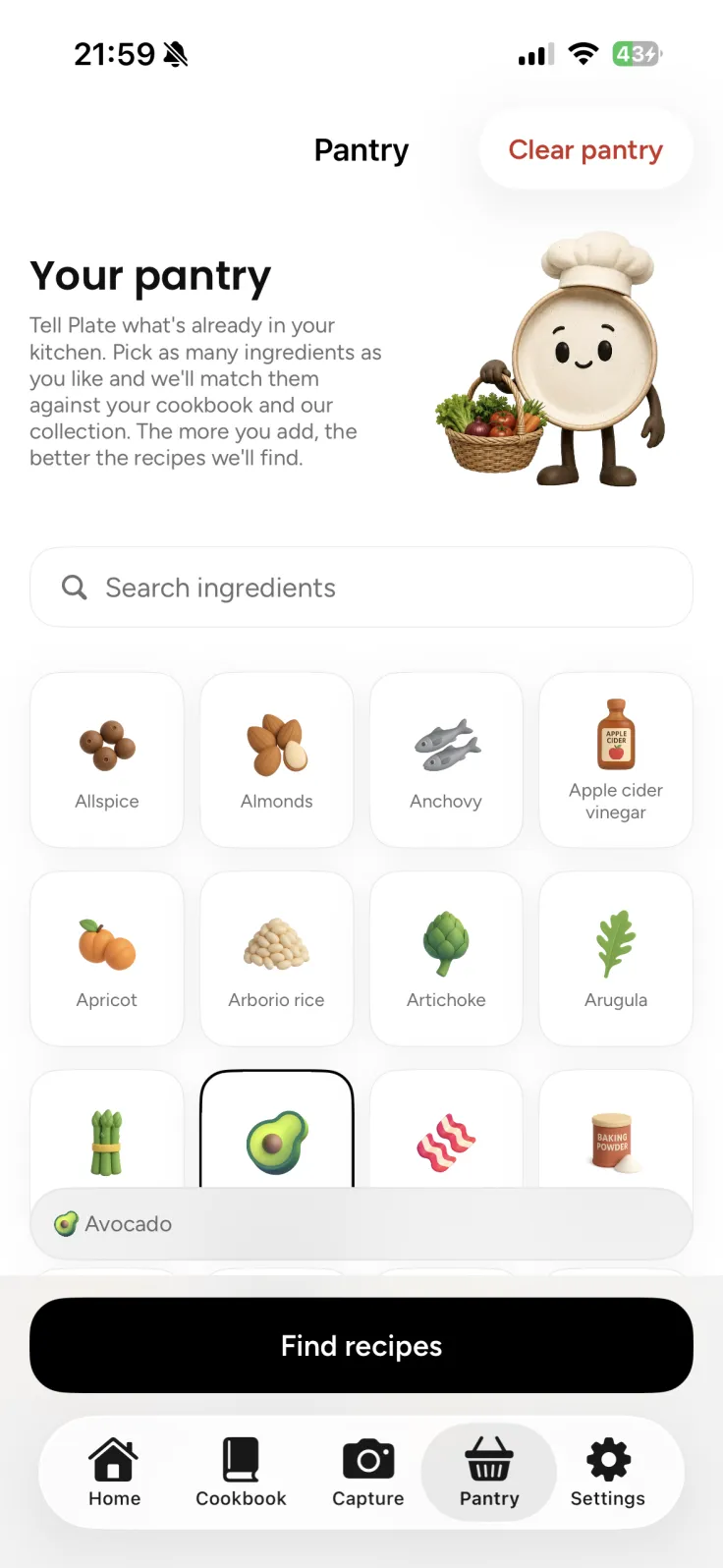
- See what's at home. Tap the ingredients in your kitchen and Plate finds recipes you can make right now, ranked by how much of your pantry they use. If the gap is too big, cook with what you have instead. A pantry staples list keeps most swaps within reach.
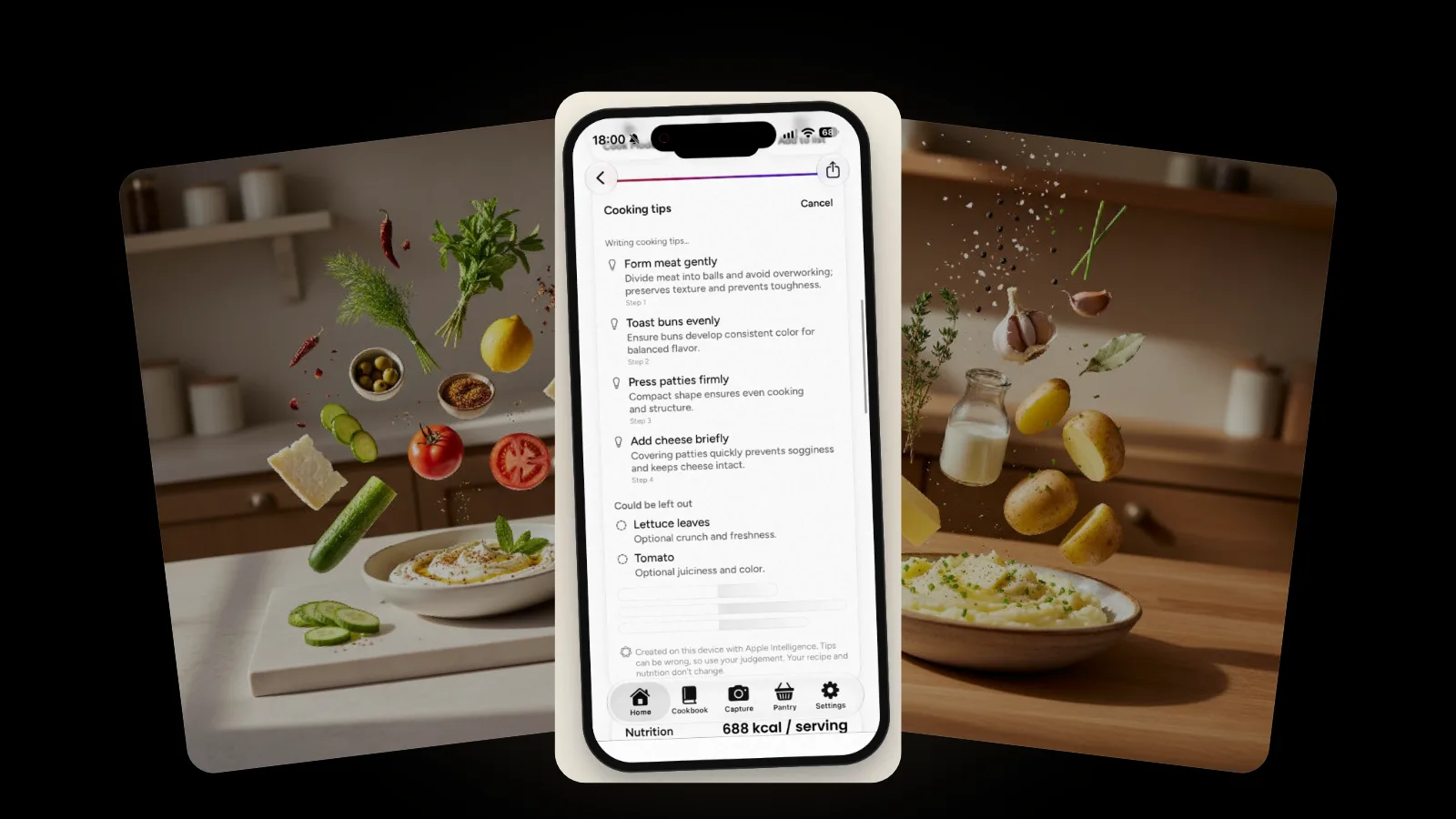
- Get tips on your iPhone. On supported devices, Apple Intelligence adds cooking tips and optional extras privately on your iPhone, like the Could be left out list in the image at the top of this guide.
- Recheck the tags. Allergen and dietary tags appear on every Plate recipe. They're AI estimates from the ingredient list, so they describe the recipe you saved, not the swap you made at the stove.
More kitchen guides are in the Plate category.
FAQ
What can I use instead of buttermilk?
Mix 1 tablespoon of lemon juice or vinegar with enough milk to make 1 cup and let it stand 5 minutes, per the Illinois and Texas A&M AgriLife charts. Plain yogurt works cup for cup.
Can I use baking soda instead of baking powder?
Only with an acid. The charts replace 1 teaspoon of baking powder with 1/4 teaspoon of baking soda plus 5/8 teaspoon of cream of tartar. On its own, baking soda is a base that needs an acid, such as buttermilk, yogurt or vinegar, to react.
How much dried herb equals fresh?
Use 1 teaspoon of dried herbs for every tablespoon of finely cut fresh herbs. NDSU, Kansas State and Colorado State all give that ratio.
Is an ingredient substitute safe for someone with a food allergy?
Not automatically. Substitution charts are about texture and flavor, not allergens, and swaps such as 2 egg whites are still egg. Read every packaged replacement's label and ask your guest.
Get started
Before your next recipe, tick through the ingredients first and keep this page handy for any gap. To keep your recipes, pantry and allergen tags in one place, Plate is free to start on the App Store, and the Plate page shows what else it can do.